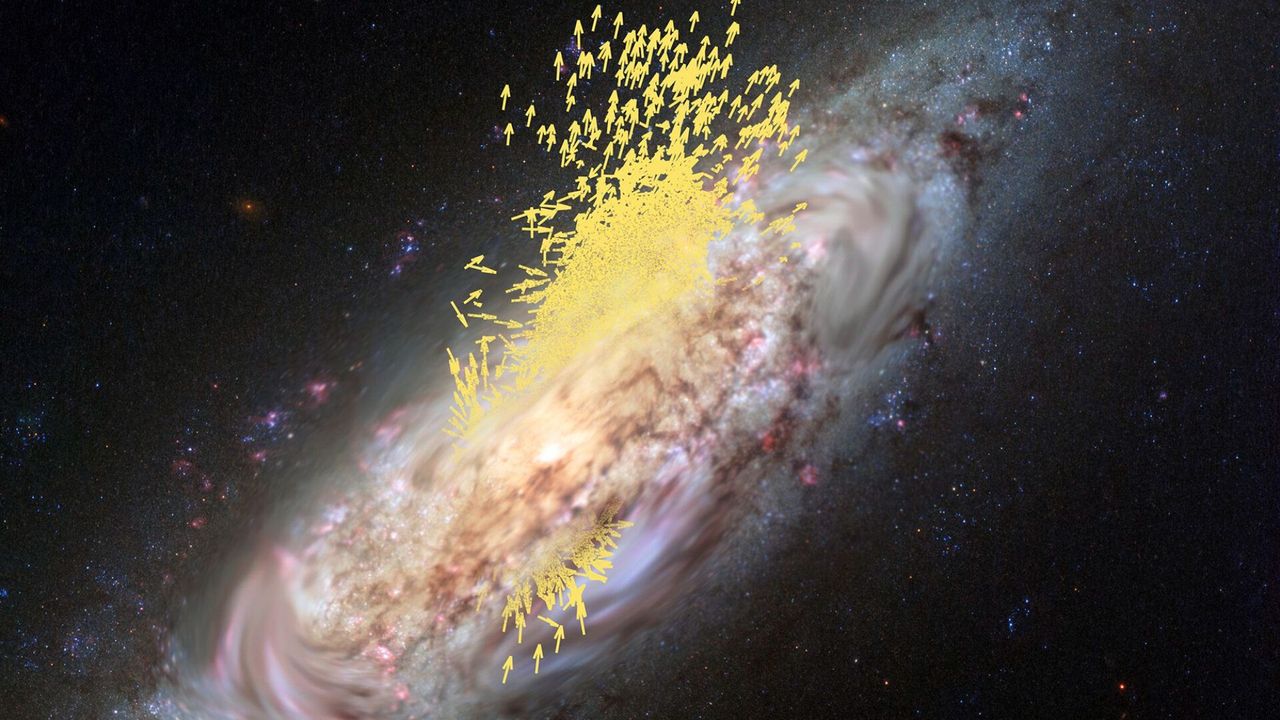
Astronomers have uncovered evidence that the Milky Way experienced a dramatic 90-degree rotation in its distant past, a finding revealed through analysis of the galaxy's stellar halo.
The discovery centers on observations of the stellar halo, the spherical cloud of ancient stars that surrounds the galactic disc. Researchers found that this halo rotates slowly relative to the plane of the galaxy's spiral disc. This misalignment provided the crucial clue to reconstructing what scientists believe was a major collision or gravitational interaction event billions of years ago.
The mechanism behind the flip likely involved a merger with another galaxy or a significant gravitational encounter that fundamentally altered the Milky Way's orientation. During such an event, the encounter would have been violent enough to reorient the entire galactic structure, causing the disc to rotate perpendicular to its original position. The stellar halo, composed of older stars, retained a different rotational axis than the younger stars in the main disc, creating the observable mismatch researchers detected.
This finding reshapes our understanding of the Milky Way's formative history. Galaxies experience mergers and interactions throughout their evolution, but identifying specific transformative events requires careful observation of their structural remnants. The slowly rotating halo acts as a fossil record of past dynamics.
The research builds on growing evidence that major galactic mergers shape galaxy morphology and kinematics. Comparable studies of other galaxies have shown similar signs of past collisions, but pinpointing such events in our own galaxy remains challenging due to our position within it.
Scientists did not yet fully explain why this rotation occurred or what specific galactic encounter caused it. Future observations using advanced telescopes and refined models of galactic dynamics may provide more detailed scenarios of the collision event and its timeline. Understanding these ancient transformations helps astronomers piece together how spiral galaxies like ours assemble and evolve