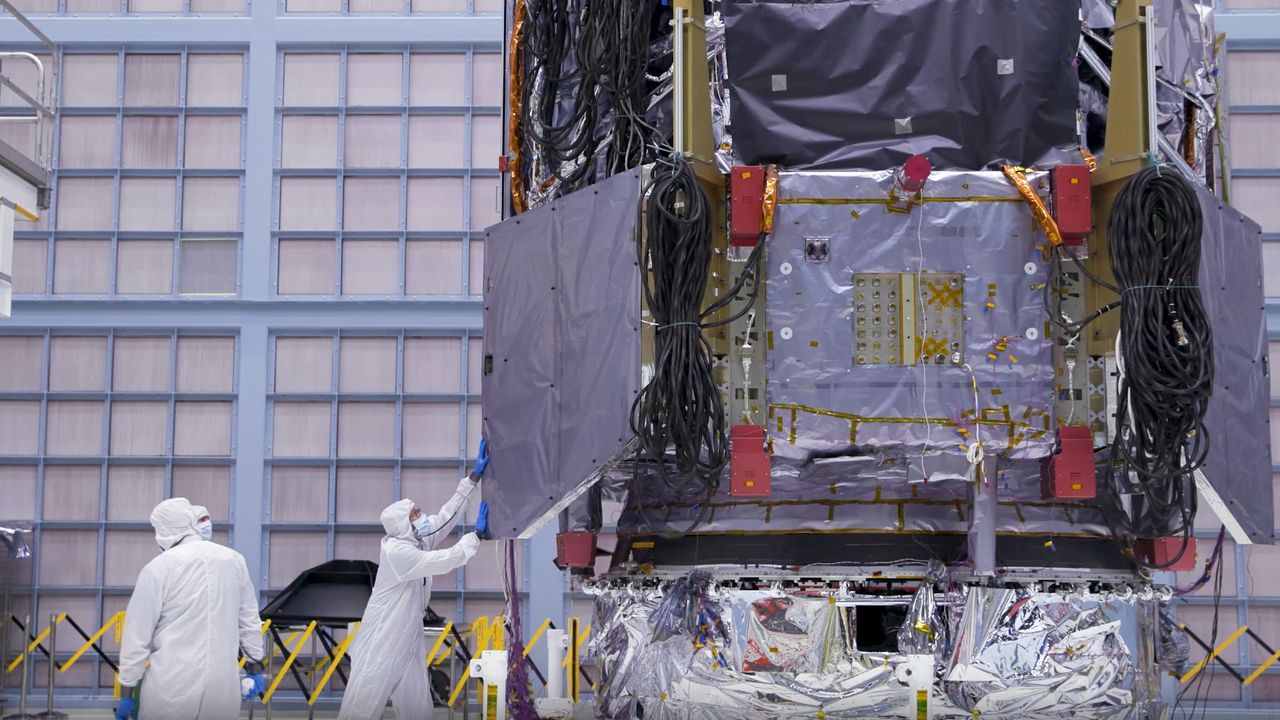
NASA began fueling operations for the Nancy Grace Roman Space Telescope, advancing preparations for its scheduled August 30 launch. The space agency is loading propellant into the observatory's tanks as it reaches the final stages before liftoff.
The Roman Space Telescope represents a major addition to NASA's astrophysics fleet. Named after pioneering NASA astrophysicist Nancy Grace Roman, the observatory will observe the universe in infrared wavelengths with capabilities designed to complement the James Webb Space Telescope. Roman's primary mission focuses on studying dark energy, mapping the structure of the universe, and searching for exoplanets.
The telescope features a 2.4-meter primary mirror, the same diameter as the Hubble Space Telescope, but with infrared instruments tailored for wide-field observations. Its Wide Field Instrument will capture images across a field of view roughly 100 times larger than Hubble's equivalent camera, enabling surveys of billions of galaxies and stars in single observations. The mission will also carry a coronagraph designed to directly image exoplanets and study their atmospheres.
NASA developed Roman at Goddard Space Flight Center in Maryland with contributions from industry partners and international collaborators. The project faced numerous delays and budget pressures since its inception, with the launch date shifting multiple times over the past decade. August 30 represents the current target, though space missions frequently experience schedule adjustments during final countdown phases.
The fueling milestone indicates that integration and pre-launch testing have progressed sufficiently to move into propellant loading procedures. This process typically occupies the final weeks before launch, with technicians carefully managing cryogenic and hypergolic propellants required for orbit insertion and station-keeping maneuvers once Roman reaches space.
Once operational, Roman will join an expanding constellation of space-based observatories studying the cosmos. The telescope addresses fundamental questions in cosm