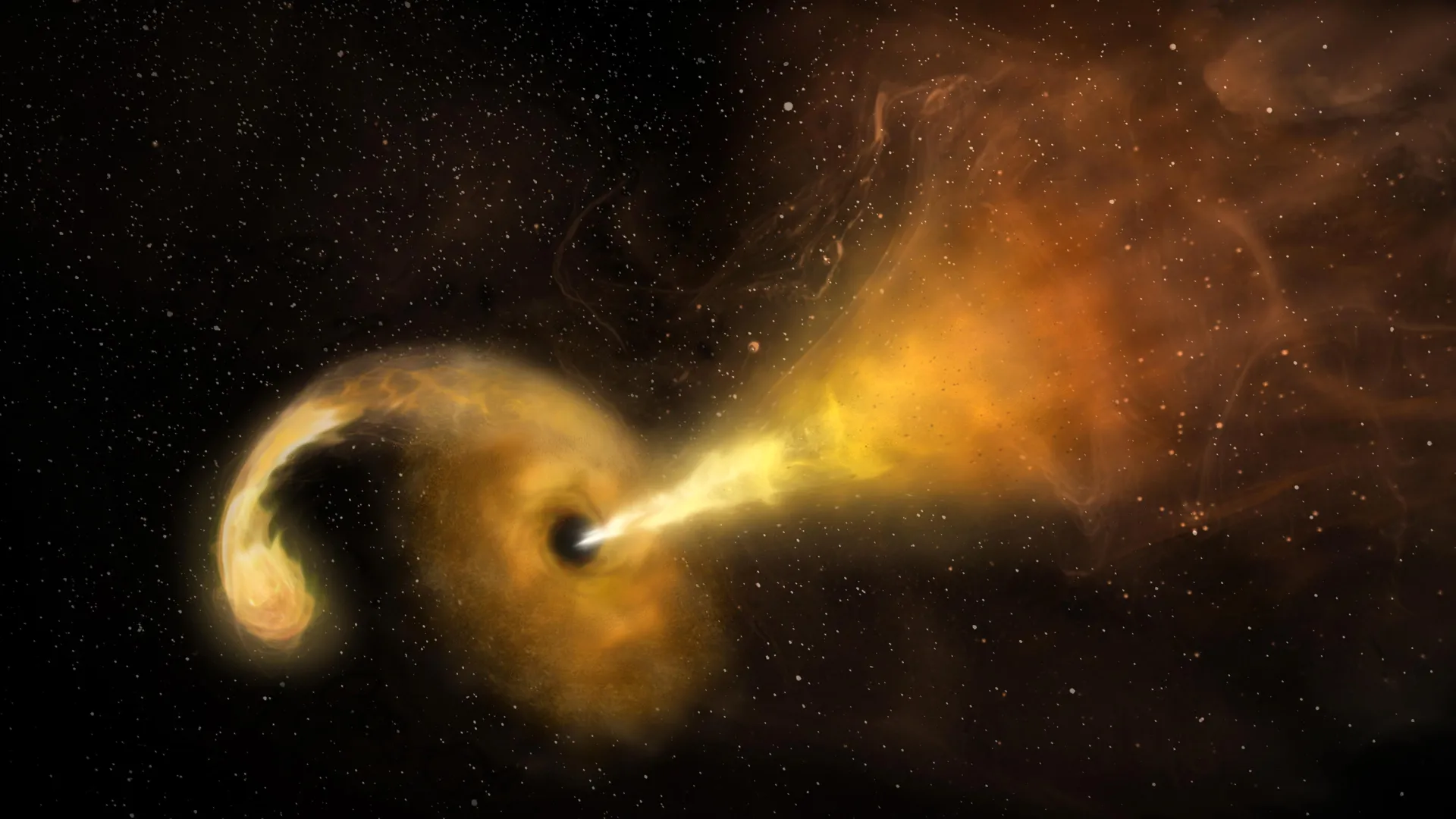
NASA's Swift Observatory detected a supermassive black hole tearing apart a star at extraordinary brightness levels. The event occurred in a galaxy located more than 30,000 light-years away and temporarily outshone the entire host galaxy in ultraviolet wavelengths.
The black hole responsible for the destruction weighs approximately one million times the Sun's mass. This classification places it as a wandering intermediate-mass black hole, distinct from the supermassive black holes typically found at galactic centers. The observation represents a rare capture of such an object actively consuming stellar material.
Swift, NASA's space telescope designed to detect gamma-ray bursts and transient events, captured the tidal disruption event (TDE) as it unfolded. During a TDE, a star ventures too close to a black hole's gravitational pull, which stretches and tears it apart. The extreme heat generated from infalling material creates a luminous display across multiple wavelengths.
The brevity and intensity of the flare provided astronomers with crucial data about the black hole's properties and feeding behavior. Ultraviolet observations prove particularly valuable for understanding these events because they directly trace the hottest regions near the black hole's accretion disk.
Wandering intermediate-mass black holes remain poorly understood objects in astronomy. Most known black holes either represent stellar-mass remnants from dead stars or supermassive objects anchoring galactic centers. Finding one actively disrupting a star outside a galaxy's nucleus offers a window into their prevalence and behavior.
The observation demonstrates Swift's continued capability to identify violent cosmic events across vast distances. The telescope's rapid response to transient phenomena allows researchers to gather data during the brightest phases of astronomical explosions. Such observations accumulate evidence about black hole demographics and the frequency of stellar encounters in galactic regions far from centers.
The findings expand the catalog of tidal disruption events