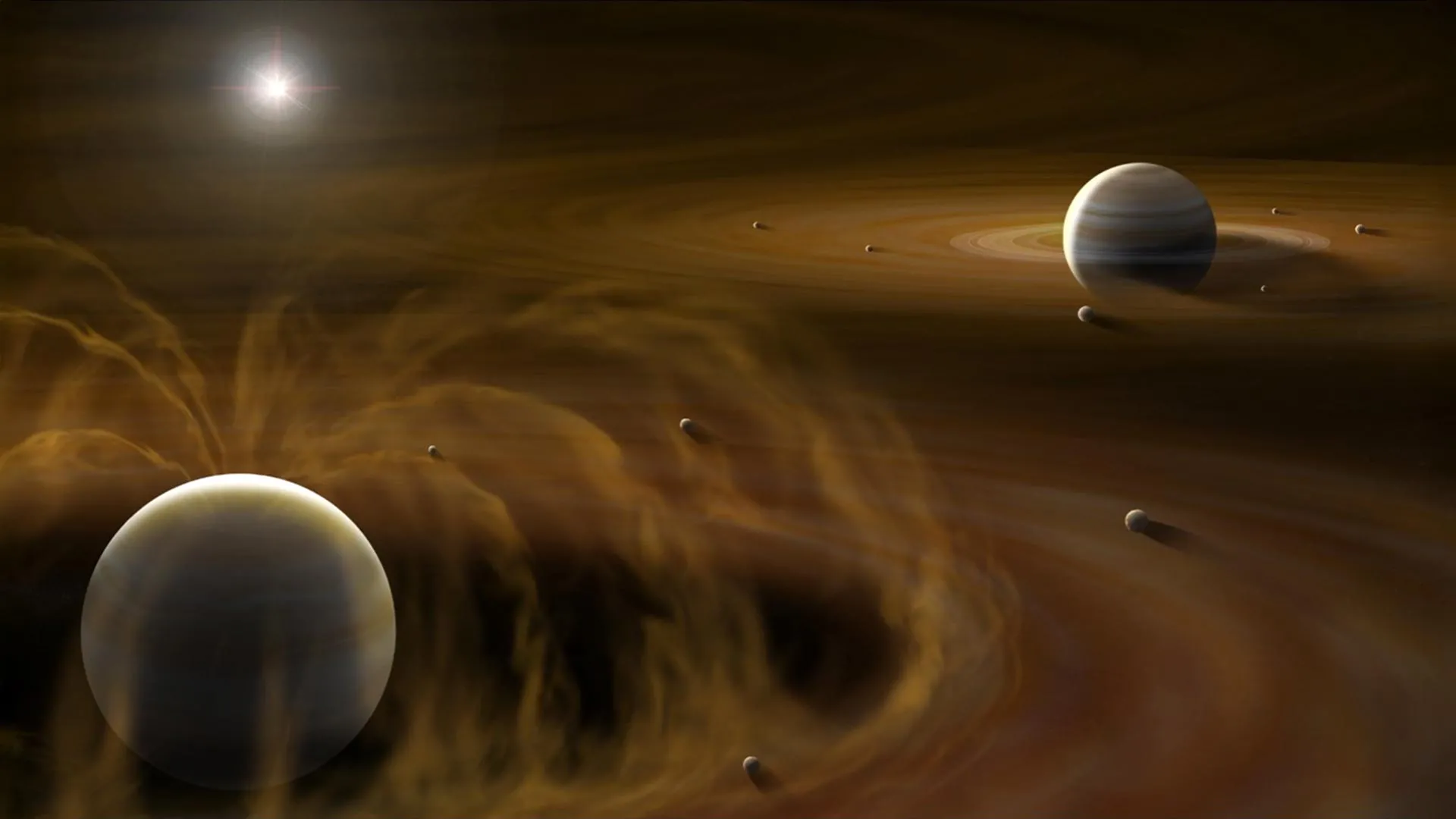
Jupiter's early magnetic field created conditions that allowed multiple giant moons to form and survive, while Saturn's weaker magnetosphere left it vulnerable to moon-destroying processes, according to new research on planetary moon systems.
The study proposes that Jupiter's intense magnetic environment during its youth established a protected zone where large moons could coalesce without being destroyed by incoming debris or electromagnetic forces. This magnetic cocoon enabled the formation of the Galilean moons, Io, Europa, Ganymede, and Callisto, which rank among the largest moons in the solar system.
Saturn, by contrast, possessed a weaker early magnetic field that offered no comparable protection. This left Saturn's potential large moons exposed to destructive forces that prevented their formation or caused their destruction. Consequently, Titan emerged as Saturn's sole truly giant moon, orbiting in relative isolation compared to Jupiter's entourage of massive satellites.
The research addresses a long-standing puzzle in planetary science. Jupiter hosts four moons larger than Earth's moon, while Saturn's moon system appears comparatively sparse at its upper end. Understanding these differences requires examining the conditions present during the early solar system, when these planetary systems took shape.
Magnetic fields generated by giant planets arise from dynamos in their interiors, where rapidly rotating liquid cores produce electrical currents. The strength and extent of these fields vary dramatically among planets and change over time as planets cool and evolve. Jupiter's particularly robust magnetosphere may reflect its larger size and higher internal temperatures during its formative period.
The findings appear in recent planetary science literature examining moon formation mechanisms around gas giants. Researchers emphasize that early magnetic environment represents just one factor influencing moon system architecture. Other processes, including gravitational interactions, collision dynamics, and material availability in protoplanetary disks, also shaped the final configurations.
The work offers insights into exoplanet systems as well. Astronom