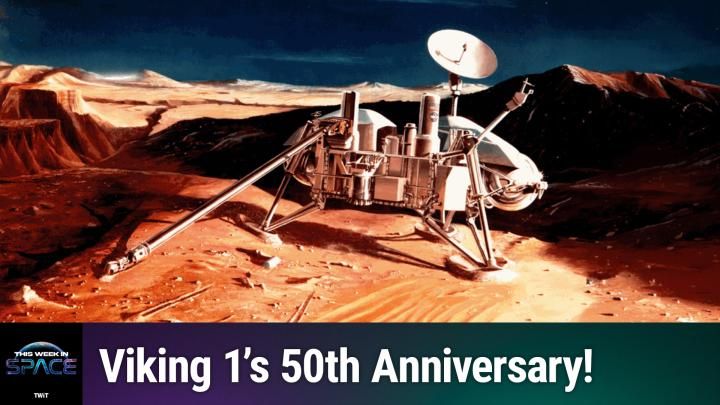
Rod Pyle and Tariq Malik hosted Episode 220 of the This Week In Space podcast this week, bringing on Dr. Pascal Lee and astrobiologist Dr. Penny Boston to commemorate the 50th anniversary of Viking 1's historic landing on Mars.
Viking 1 touched down on the Martian surface on July 20, 1976, becoming the first spacecraft to land successfully on another planet and conduct scientific research. The mission fundamentally changed humanity's understanding of Mars, transmitting the first images from the surface and analyzing soil samples for signs of life. Despite finding no definitive biological signatures, Viking 1 established Mars as a scientifically rich destination worthy of sustained exploration.
Lee, a planetary scientist, and Boston, an expert in extreme microbial life, offered insights into what Viking 1 accomplished and how its legacy shaped modern Mars exploration. The mission proved that rovers and landers could survive the harsh Martian environment and conduct meaningful science.
Today, Mars hosts multiple active rovers and orbiters operated by NASA, China, and the European Space Agency. The questions Viking 1 helped frame remain central to current missions: whether Mars once harbored life and whether it could support human settlement. Perseverance, NASA's current flagship rover, continues searching for biosignatures and collecting samples for future return to Earth.
The podcast episode arrived as NASA and other space agencies prepare for the next phase of Mars exploration, including human missions planned for the 2030s and 2040s. Understanding Viking 1's achievements provides context for why Mars remains the top priority for planetary exploration.