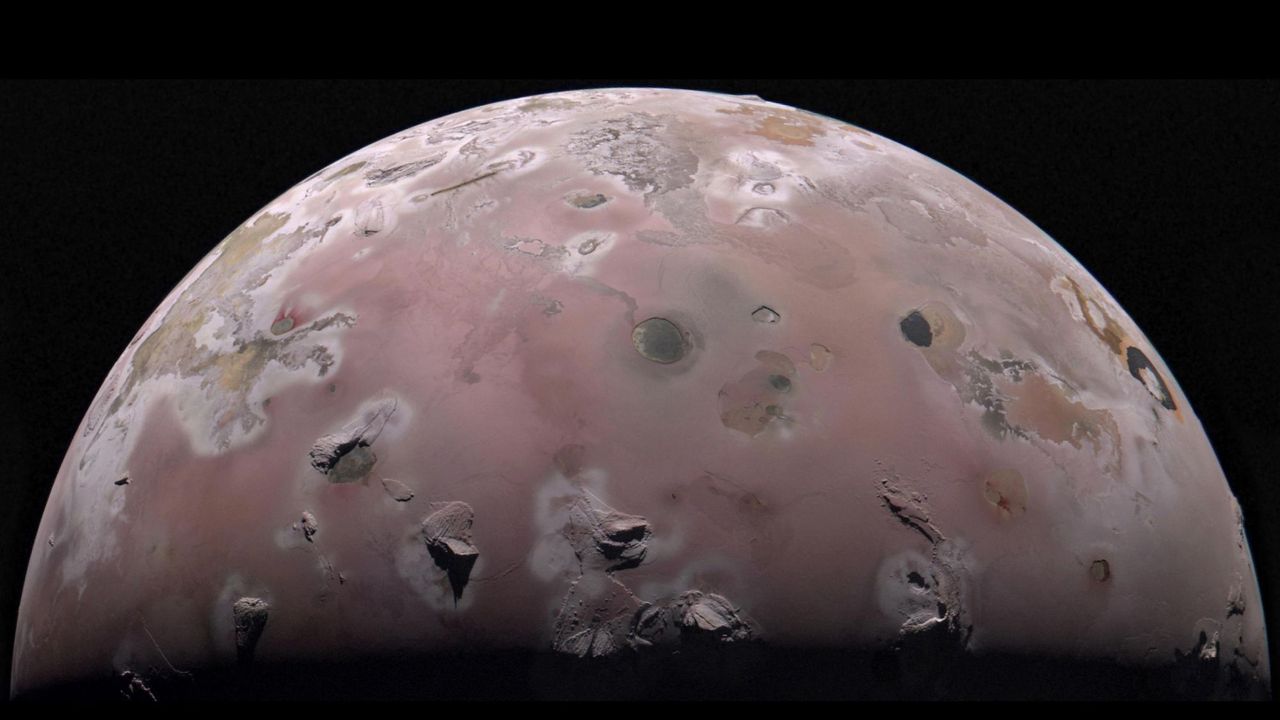
NASA's Juno spacecraft has provided unprecedented views of the subsurface structure beneath Io's volcanoes, offering scientists direct evidence of what drives one of the solar system's most geologically active bodies.
The mission collected data revealing the internal composition and heat distribution under Io's volcanic regions. This information allows researchers to better understand the mechanisms fueling the moon's extreme volcanism, which stems from tidal heating generated by Jupiter's gravitational pull.
Io hosts over 400 active volcanoes, making it the most volcanically active body in our solar system. The Juno observations employed the spacecraft's magnetometer and radiation instruments to penetrate beneath the surface, mapping subsurface magma reservoirs and thermal anomalies that traditional optical imaging cannot detect.
The findings carry implications extending far beyond Jupiter's system. Understanding Io's volcanic plumbing provides a natural laboratory for studying magma dynamics, crustal deformation, and heat transport in extreme environments. These principles apply directly to terrestrial volcanoes on Earth, where similar physical processes operate but under different conditions.
Scientists can now refine models of volcanic behavior by examining how a body with constant tidal stress maintains such prolific eruptive activity. This knowledge improves forecasting capabilities for volcanic hazards on Earth and helps predict behavior on other geologically active worlds.
The research also informs the search for life on icy moons. Europa and Enceladus, which harbor subsurface oceans, rely on internal heat sources that researchers can better characterize using lessons from Io. Tidal heating mechanisms that power Io's volcanoes may similarly sustain hydrothermal activity beneath the ice shells of ocean worlds, potentially supporting microbial ecosystems.
Juno's subsurface findings represent a shift in planetary science methodology. Rather than relying solely on surface observations, scientists increasingly use gravitational and magnetic