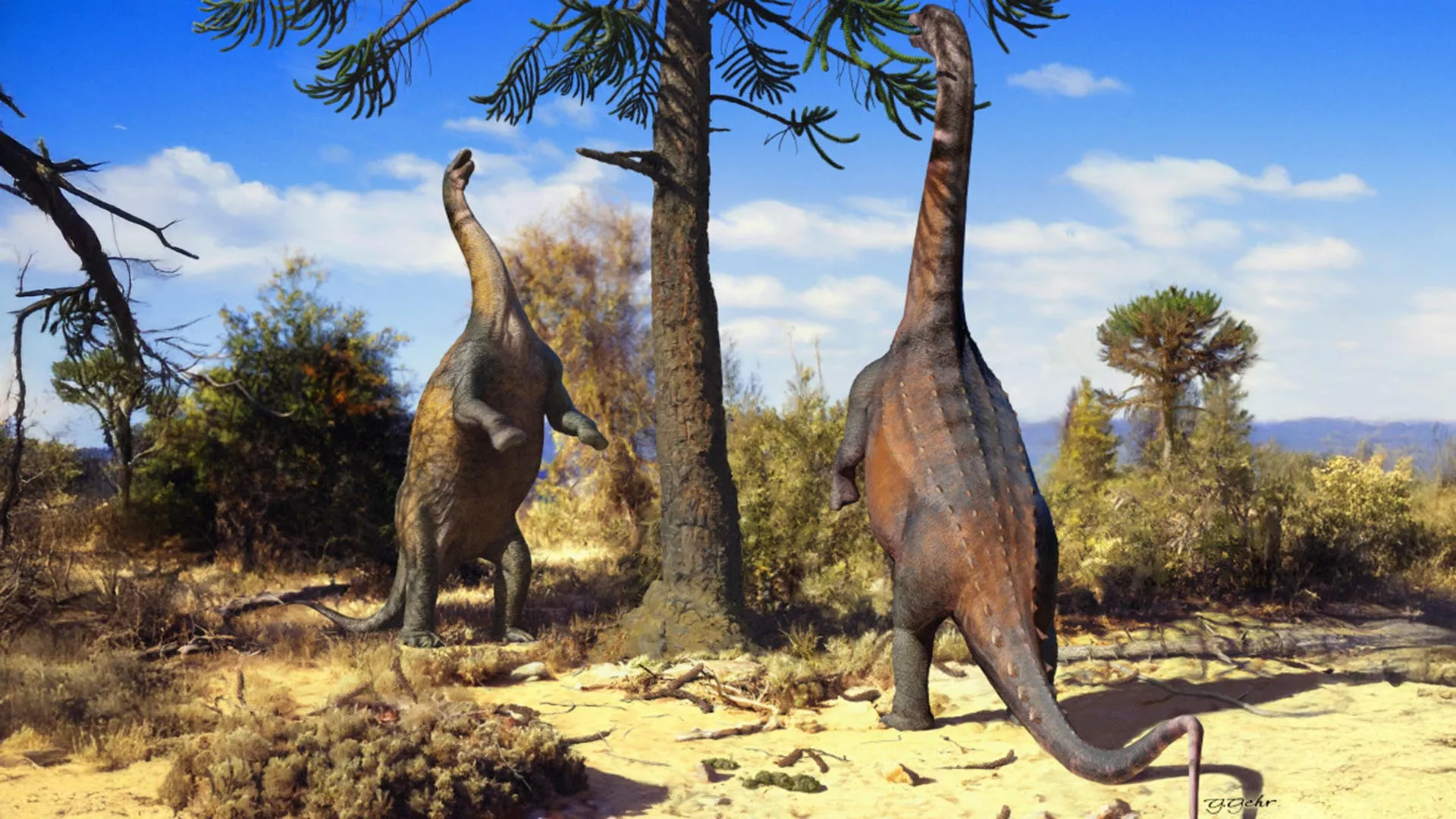
Researchers reconstructed the biomechanics of two medium-sized South American sauropods and discovered they possessed skeletal architecture uniquely suited for rearing up on hind legs. Using digital modeling, scientists tested how well the dinosaurs' femurs withstood the extreme forces generated during bipedal posturing, comparing results across multiple sauropod species of varying sizes.
The findings reveal a striking pattern. The elephant-sized sauropods showed superior load-bearing capacity in their leg bones relative to larger sauropod species, particularly during their younger years. This architectural advantage disappeared as these dinosaurs matured and gained mass, suggesting bipedalism became biomechanically infeasible once they exceeded certain weight thresholds.
The research addresses an enduring question about sauropod behavior. Scientists have long debated whether these massive herbivores could assume upright postures, with fossil evidence offering only indirect clues. Digital biomechanical analysis now provides concrete data on skeletal stress and strain under hypothetical rearing scenarios.
The ability to rear up likely conveyed multiple survival advantages. Reaching high into canopy vegetation would grant access to nutritious foliage inaccessible to quadrupedal competitors. Vertical posturing could intimidate predators by increasing apparent size. Males might also employ the dramatic posture during territorial or reproductive displays to attract mates.
The study demonstrates how body size fundamentally constrains locomotor possibilities. As sauropods grew, gravitational forces and inertial loads increased exponentially. What remained biomechanically feasible at elephant scale became prohibitively expensive at 60 or 80 tons. Young individuals could exploit this developmental window, then abandon the behavior as they matured into obligate quadrupeds.
This research illustrates the power of computational paleontology to test behavioral hypotheses impossible to examine directly. By applying engineering principles to fossil anatomy,