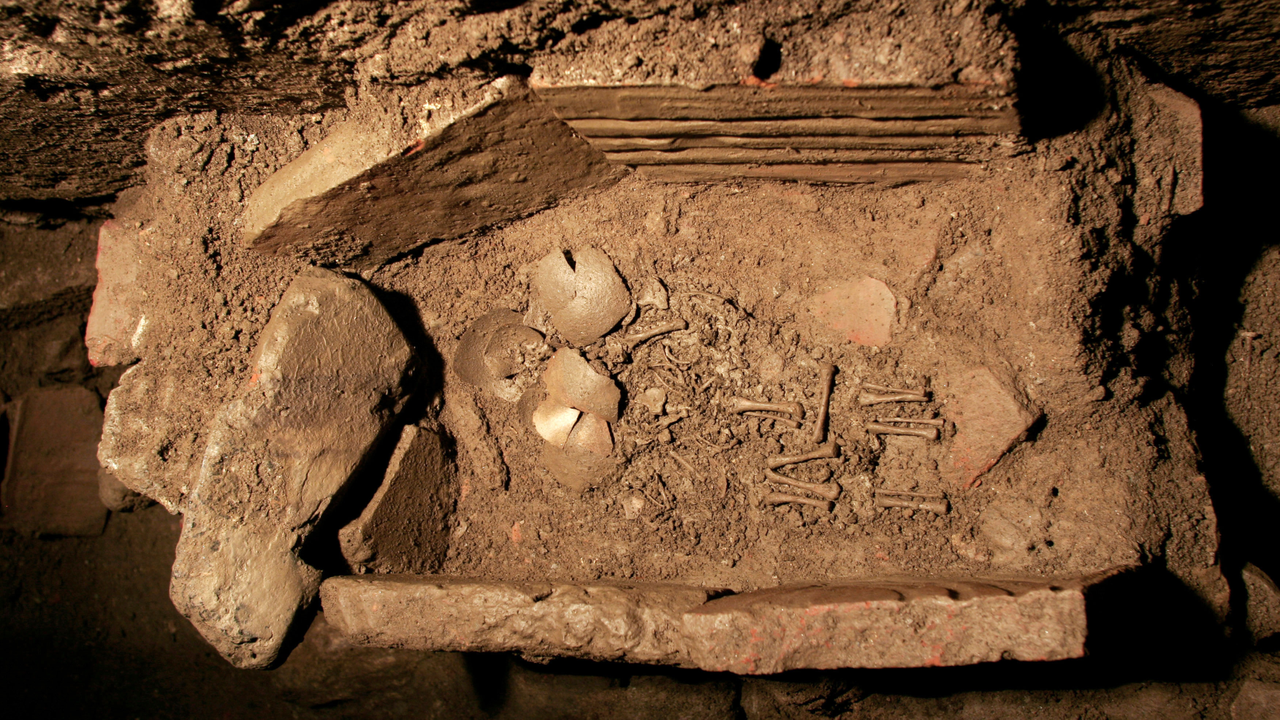
Archaeologists in Turkey have uncovered a Byzantine-era grave containing two infants who likely died at birth or shortly thereafter, representing a rare discovery of twins from the 8th or 9th century. The burial site sits near the Temple of Artemis in Ephesus, one of the ancient world's most significant structures.
The skeleton of one infant exhibits a notable anatomical variation: an extra rib, a condition known as cervical ribs or thoracic ribs. Such developmental anomalies occur when vertebrae near the neck or upper spine produce additional ribs beyond the typical twelve pairs. While cervical ribs affect roughly 0.5 to 1 percent of modern populations, finding this trait preserved in ancient skeletal remains provides researchers with biological data from centuries past.
The dual burial practice reflects Byzantine attitudes toward infant mortality and family grief during a period when high neonatal death rates were common. Placing twins together in a single grave suggests intentional, deliberate burial rather than accidental co-interment. The proximity to the Temple of Artemis, which continued to hold religious and possibly cultural significance during the Byzantine period, indicates the infants received formal burial treatment.
The discovery offers paleopathologists and bioarchaeologists insight into ancient health conditions and burial customs. The presence of the extra rib in one twin raises questions about whether the anomaly contributed to the infant's death or merely represents incidental skeletal variation. Byzantine medical texts and practices provide limited direct evidence about how physicians and families understood such conditions at the time.
The Temple of Artemis location makes this find historically layered. The temple itself dates to the 6th century BCE, but the Byzantine cemetery demonstrates continued use of the sacred site nearly a millennium later. This archaeological continuity reveals how religious spaces maintained importance across shifting cultural and religious boundaries.
The remains now contribute to broader datasets examining ancient infant mortality, genetic