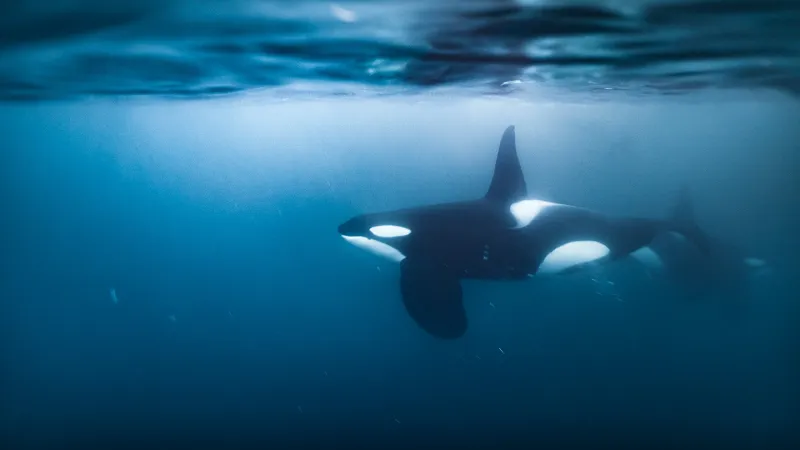
Researchers studying orca predation have documented a striking hunting technique: orcas ramming sunfish at such high velocity that the impact kills the prey instantly.
The behavior represents an addition to the well-documented hunting strategies orcas employ across different populations and prey types. Orcas hunt seals by beaching themselves on ice floes, coordinate to create waves that wash prey overboard, and use echolocation to pursue fish in kelp forests. The sunfish ramming tactic demonstrates their capacity to adapt killing methods to match prey characteristics.
Sunfish, or mola, are massive ocean fish that can weigh over 5,000 pounds but lack agility and defensive capabilities. An orca traveling at speed can deliver a devastating blow to the fish's body. The impact transfers enough force to cause fatal trauma, allowing the orca to feed on the carcass afterward.
This observation comes from marine biologists tracking orca populations in various ocean regions. The behavior appears concentrated in groups where sunfish abundance makes this hunting style viable. Different orca populations specialize in different prey based on local availability and learned cultural hunting traditions passed through generations.
The finding adds to a growing body of research showing orcas rank among the ocean's most intelligent and behaviorally flexible predators. They learn hunting techniques from older individuals within their pods, establishing distinct cultural practices that vary by region. Some orca populations hunt whales, others fish, and still others focus on seals or sea lions.
The ramming strategy also illustrates how apex predators adjust their methods based on prey morphology. Sunfish present a different challenge than a fleeing seal or a coordinated school of fish, requiring a direct kinetic approach rather than a cooperative maneuver.
Understanding these hunting behaviors provides insight into marine ecosystem dynamics and predator-prey relationships. As ocean conditions change with warming waters and shifting fish populations, studying how