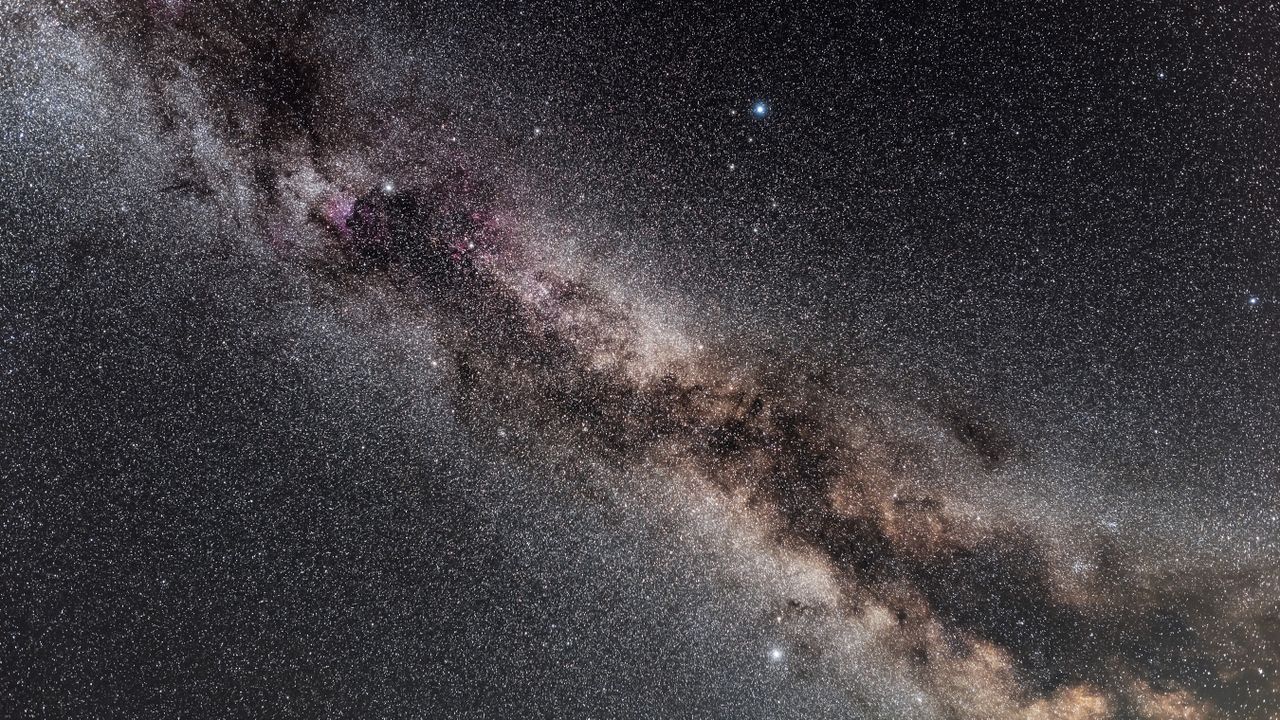
Three bright stars form a celestial landmark that unlocks summer stargazing for beginners. Vega, Deneb, and Altair compose the Summer Triangle, an asterism visible in the Northern Hemisphere from June through September. These stars serve as navigation anchors that help observers locate dozens of constellations and deep-sky objects.
Vega, the brightest of the three, sits in the constellation Lyra. Deneb marks the tail of Cygnus the Swan. Altair resides in Aquila the Eagle. Together they create a large triangle spanning roughly 60 degrees across the sky, making them impossible to miss once you know where to look.
The Summer Triangle's utility comes from its size and brightness. The three stars remain high overhead throughout summer evenings, providing stable reference points for navigating toward fainter targets. Observers can use the triangle's edges and internal geometry to pinpoint neighboring constellations like Hercules, Draco, and Sagittarius. The Milky Way cuts through the triangle's interior, offering a natural pathway to explore star clusters and nebulae.
Beginning stargazers benefit from learning the Summer Triangle before attempting to identify individual constellations. The pattern teaches the fundamentals of celestial navigation without requiring binoculars or telescopes. Naked-eye observation works perfectly, assuming reasonably dark skies away from light pollution.
The Summer Triangle remains visible until early autumn, offering a window measured in months rather than weeks. This extended visibility allows observers to build familiarity with the pattern across multiple nights, reinforcing their mental map of the summer sky.
Planetarium apps and star charts can supplement naked-eye observation by showing precisely which stars comprise the triangle and what surrounds it. Many observers carry printed charts to the field, though smartphone apps offer real-time position data matched to viewing location and time.