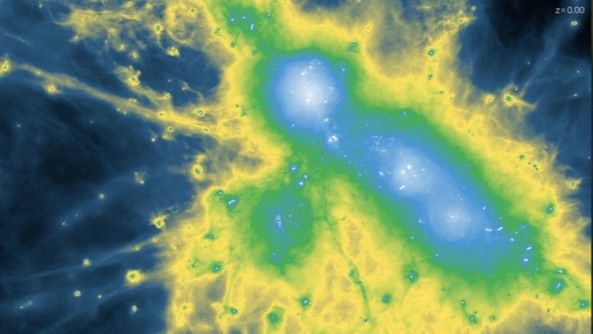
Astronomers have discovered evidence that a substantial portion of the universe's missing ordinary matter was violently ejected from galaxies and now drifts in the space between them, according to research published recently in astrophysical journals.
The discrepancy between predicted and observed ordinary matter in the cosmos has puzzled physicists for decades. Current models suggest the universe should contain roughly ten times more ordinary matter than observations reveal within galaxies themselves. This "missing matter" problem has driven researchers to search intergalactic space for the displaced material.
A new analysis of observational data reveals that powerful outflows from galaxies ejected this matter with far greater force than previously modeled. These galactic winds, driven by intense star formation and supermassive black hole activity, scattered ordinary matter across billions of light-years of intergalactic space. The process appears "much more violent than predicted," according to findings reported in recent publications.
Researchers identified signatures of this ejected material through absorption line analysis in light traveling from distant quasars. As this light passes through intergalactic gas clouds, it leaves characteristic fingerprints that reveal the presence and distribution of elements like oxygen, carbon, and iron.
The study has significant implications for understanding galaxy evolution and cosmic structure formation. Galactic outflows regulate how efficiently galaxies convert gas into stars. By quantifying the amount of material ejected into intergalactic space, scientists can better model why galaxies today appear chemically enriched compared to early universe predictions.
However, limitations remain. The research relies on indirect detection methods through quasar light absorption, making precise mass calculations challenging. Additionally, not all missing ordinary matter may reside in intergalactic space. Some could exist as faint dwarf galaxies, diffuse gas in galaxy clusters, or other forms difficult to detect with current technology.
This work advances the decades-long hunt for the universe's