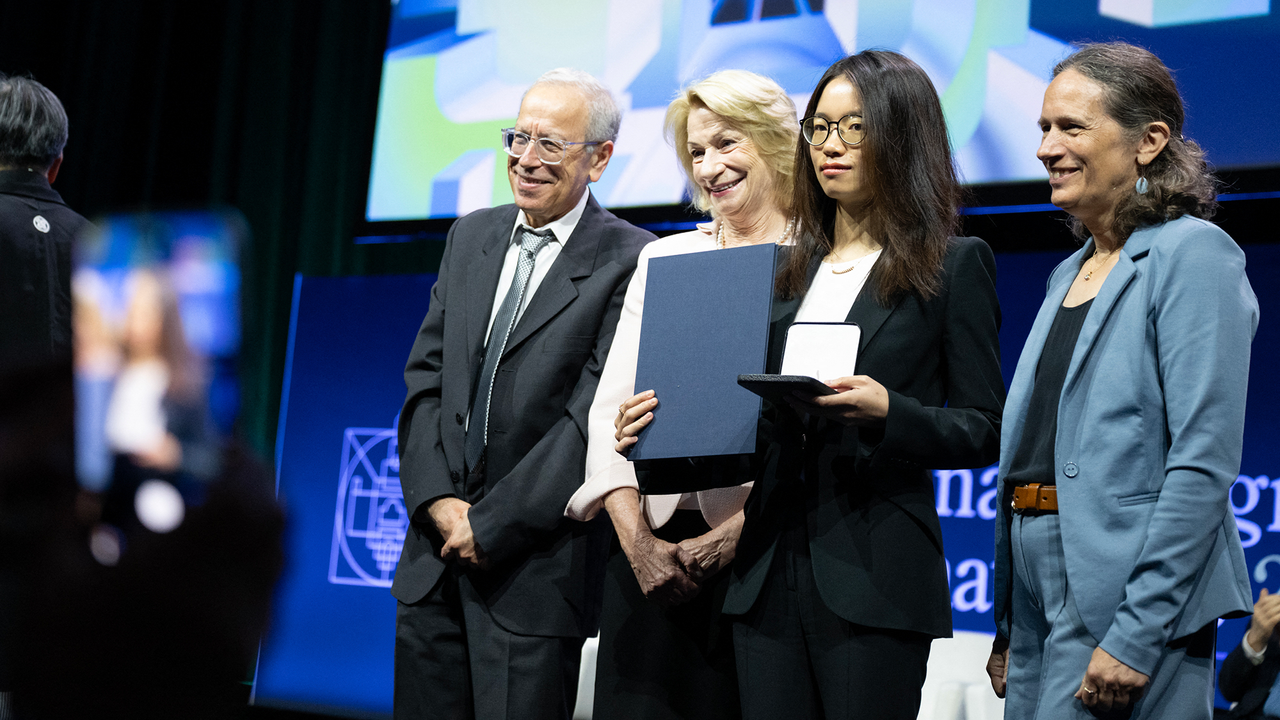
Hong Wang, a mathematician at New York University, has become the third woman to win the Fields Medal in its 90-year history. The award recognizes her breakthrough in solving a decades-old geometry problem, cementing her place among the field's most accomplished researchers.
The Fields Medal stands as mathematics' highest honor, awarded every four years to mathematicians under 40 who demonstrate exceptional talent and originality. Wang's selection underscores both her technical contributions and the slow but steady progress toward gender parity in elite mathematics. Only two women had previously claimed the prize since its establishment in 1936: Maryam Mirzakhani in 2014 and Maryna Viazovska in 2022.
Wang's work addresses a classic problem in geometry that had resisted solution for decades. Her approach combined techniques from different mathematical domains to attack the problem from new angles, demonstrating the kind of creative insight the Fields Medal committee values. The specific geometry problem she solved likely relates to questions about shapes, dimensions, or spatial relationships that have applications across pure mathematics and theoretical physics.
The recognition carries broader significance beyond Wang's individual achievement. Each woman who wins the Fields Medal creates visibility for future generations of female mathematicians, helping counter the persistent underrepresentation of women in mathematics at the highest levels. While progress remains slow, the recent appointments of Mirzakhani and Viazovska before Wang show momentum in the award's history.
Wang's position at New York University places her within one of the world's leading mathematics programs, where she contributes to research and mentors the next generation. Her work exemplifies how mathematical breakthroughs often emerge from sustained engagement with difficult problems that require both technical mastery and conceptual innovation.
The 2026 Fields Medal recognizes not just a solved problem but a mathematician whose contributions will likely influence the field's trajectory for years to come.