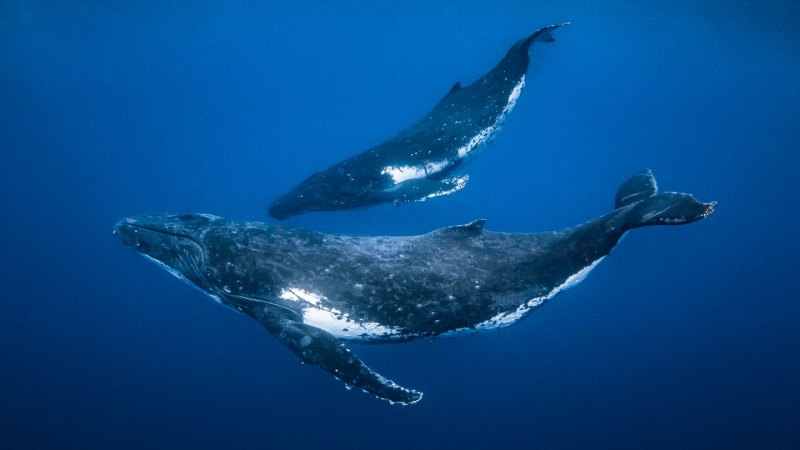
Researchers have captured the first detailed documentation of humpback whales executing a sophisticated hunting strategy near the seafloor, coordinating their movements to trap sand lances—small fish that burrow in sand.
The discovery reveals previously unknown complexity in humpback whale behavior. Scientists used underwater cameras and acoustic recordings to observe whales synchronizing their approach to the seafloor, working collectively to flush out prey from the sand and capture them efficiently. This coordinated hunting differs from the well-documented bubble-net feeding observed at the ocean surface, where humpbacks circle prey to concentrate them before lunging through the center.
The research adds to mounting evidence that humpback whales possess sophisticated social learning and teaching abilities. Distinct populations of humpbacks have developed region-specific feeding techniques passed down across generations. Surface bubble-net feeding, observed primarily in the North Atlantic and around Alaska, represents one cultural variant. Now researchers recognize another specialized strategy occurring at depth.
The significance extends beyond whale behavior documentation. Understanding how these marine mammals adapt hunting strategies to different prey types and ocean depths illuminates their ecological role as apex predators influencing fish populations and ocean health. Humpback populations have recovered remarkably since international whaling bans took effect in the 1980s, growing from dangerously low numbers to roughly 135,000 individuals today.
However, the research carries limitations. Underwater observation remains technically challenging, and scientists likely have documented only a fraction of humpback hunting techniques. The whales may employ additional strategies in deeper waters or regions difficult to access. Climate change also threatens sand lance populations through ocean warming, potentially forcing whales to shift feeding patterns and develop new adaptations.
The findings expand scientific understanding of cetacean intelligence and cultural transmission while highlighting how much remains unknown about deep-ocean predator behavior and marine ecosystem dynamics.