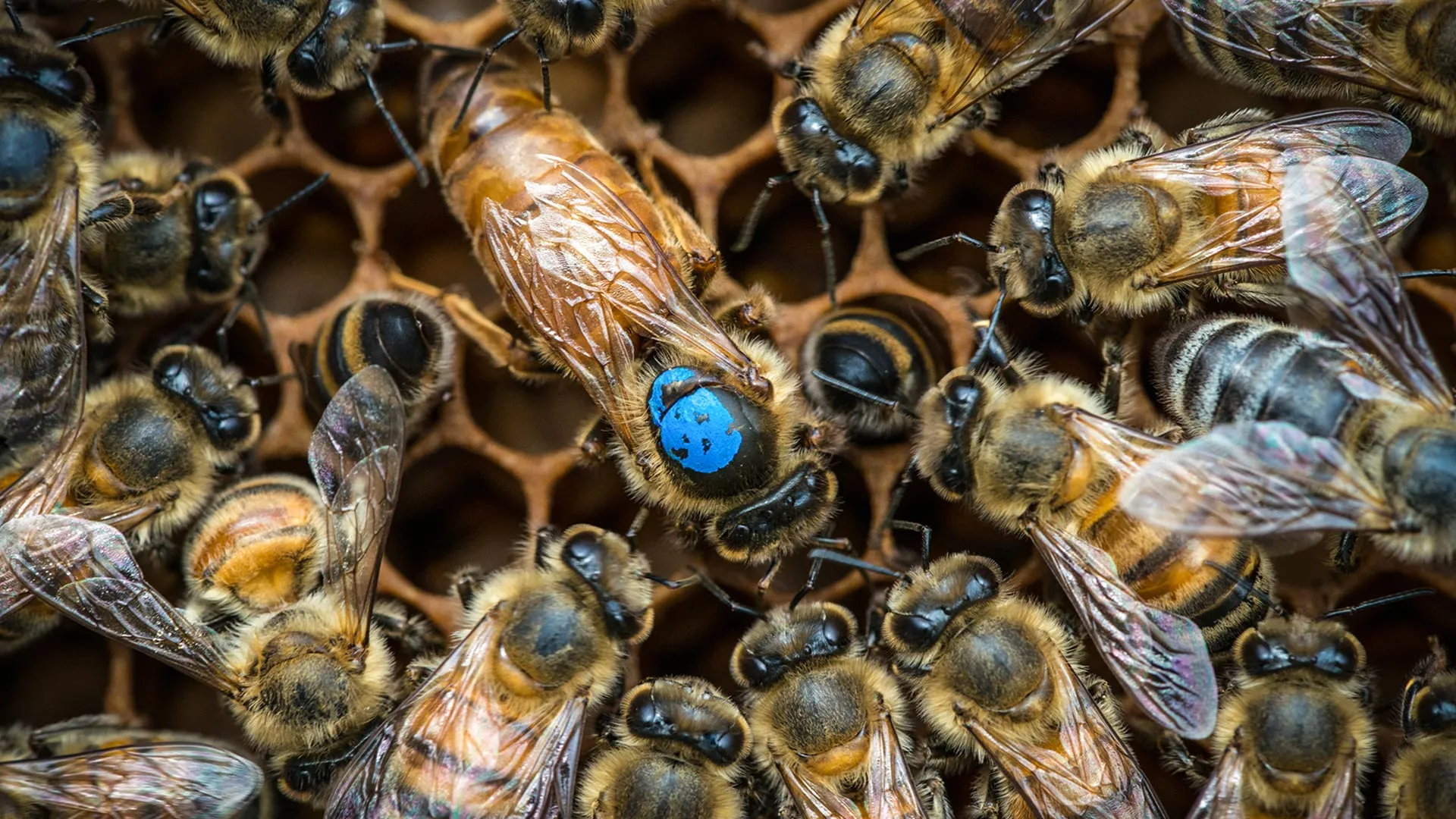
Researchers have identified neural circuits in the bee brain that control task assignment as workers age, revealing how colonies maintain their intricate division of labor. Scientists deactivated specific brain regions in older honeybees, causing them to revert to caring for the queen instead of performing their typical foraging and maintenance duties.
In a normal honeybee colony, workers progress through predictable life stages. Young bees nurse larvae and tend the queen. Middle-aged bees build comb and process food. Older bees forage for pollen and nectar. This sequential job rotation keeps the colony functioning efficiently.
The research demonstrates that this behavioral progression depends on neural circuits rather than external cues alone. When researchers switched off the identified brain circuits, temporal behavior collapsed. Aged bees abandoned their foraging responsibilities and returned to nursing tasks despite being physiologically unsuited for that work.
The study extends understanding of how animals make behavioral decisions without conscious deliberation. The bee brain contains roughly one million neurons, compared to humans' 86 billion, yet it coordinates complex social behaviors through dedicated neural pathways. These neural switches appear to operate automatically, triggered by age-related changes in the brain itself.
The findings suggest that evolution has wired job assignments directly into neural tissue rather than relying on flexible learning. This hardwired system ensures colony stability across generations. Bees cannot consciously choose their roles or negotiate tasks. Their behavior emerges from brain circuits shaped by millions of years of selection for cooperative living.
The discovery carries implications beyond apiculture. Understanding how simple brains solve complex organizational problems may inform research on human cognition, artificial intelligence, and collective decision-making. The work also highlights the vulnerability of bee colonies to disruptions affecting neural function, from pesticide exposure to diseases that damage the central nervous system.
The researchers have not yet identified which specific neurotransmitters or molecular signals activate these behavioral switches, leaving room