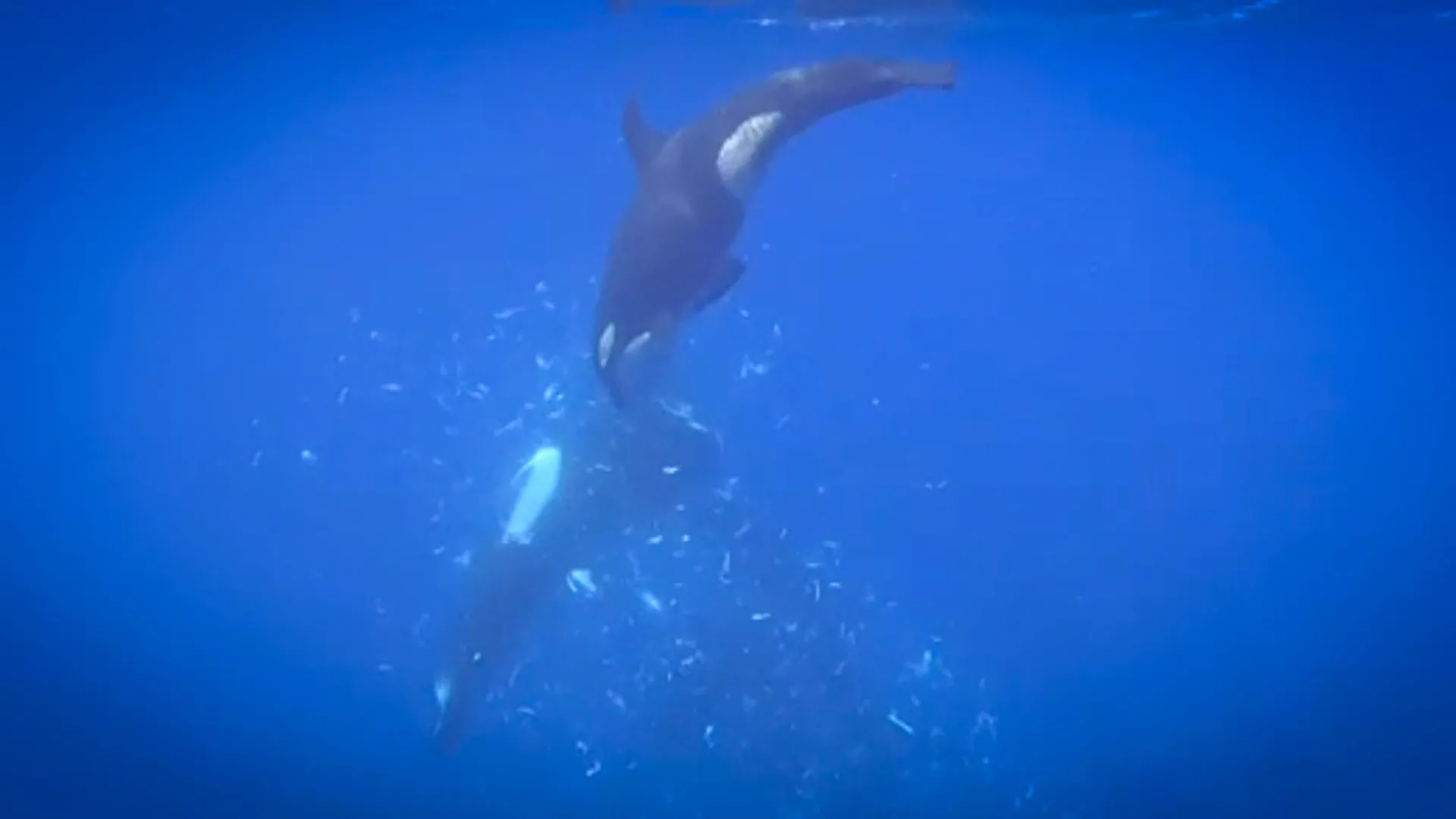
A team of researchers studying marine mammals in the Gulf of California has documented an unusual orca hunting behavior never previously recorded in the scientific literature. The researchers witnessed two separate incidents where orcas deliberately dismembered giant sunfish by holding the carcass steady while a second orca charged at it at high speed, fragmenting the body into thousands of pieces.
The behavior represents a novel foraging technique among orca populations. Rather than consuming the sunfish whole or using established butchering methods observed in other marine predators, these orcas employed what appears to be a coordinated, destructive approach. One animal gripped the sunfish by the fin to anchor it in place while its partner delivered repeated high-velocity impacts, systematically breaking apart the massive creature.
Ocean sunfish, or Mola species, rank among the heaviest bony fish alive, often exceeding 2,000 kilograms. Their size and body composition present significant challenges for predators. The documented technique suggests orcas in this region may have developed a specialized adaptation for exploiting this resource. Whether this behavior spreads through social learning or remains localized to particular orca populations remains unclear.
The Gulf of California represents a biodiversity hotspot where orcas maintain distinct cultural traditions passed through generations. Researchers have previously identified population-specific hunting behaviors in this region, including specialized techniques for hunting specific prey. This newly documented sunfish-dismemberment behavior fits within that pattern of behavioral complexity.
The observations underscore the cognitive sophistication and problem-solving abilities of orcas. Different populations demonstrate remarkable variation in foraging strategies, tool use, and prey selection. These differences appear to reflect cultural transmission rather than genetic variation alone.
The research contributes to understanding marine predator ecology and orca behavioral diversity. Further investigation into the prevalence and geographic distribution of this technique could reveal how marine mammal populations adapt hunting strategies to available resources.