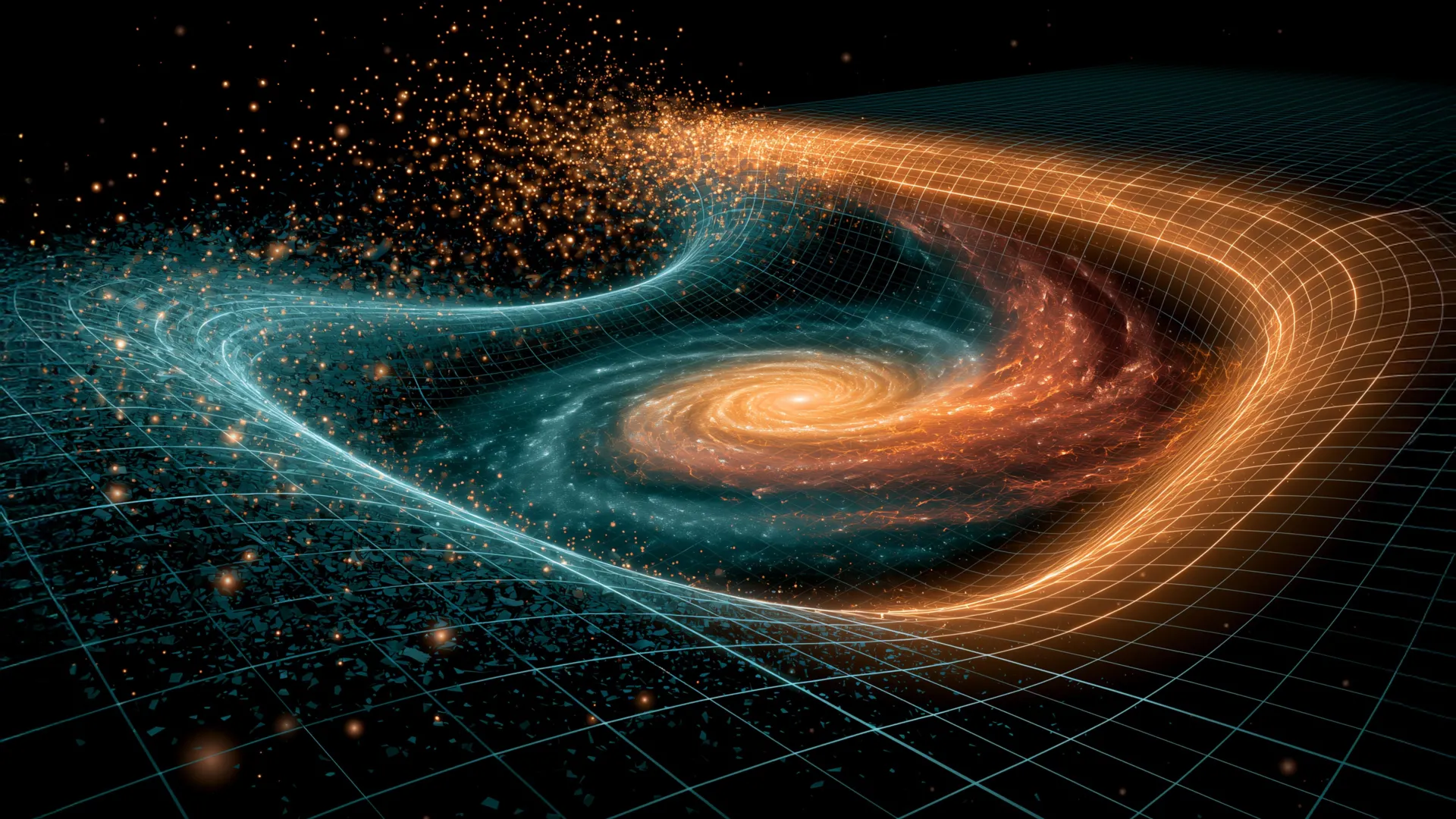
Mathematician Ginestra Bianconi proposes a resolution to a long-standing cosmological puzzle: how complexity emerges in a universe governed by thermodynamic law. Her work applies Gravity from Entropy, a quantum gravity framework, to show that the second law of thermodynamics remains intact even as stars, galaxies, and life form.
The problem Bianconi addresses is straightforward but profound. The second law states that entropy, a measure of disorder, always increases in closed systems. Yet the Universe shows remarkable organization. Galaxies cluster. Stars ignite. Life evolves. These processes require local decreases in entropy, seemingly violating fundamental physics.
Bianconi's solution hinges on distinguishing between total and local entropy. As space expands, the Universe's total entropy rises continuously. This expansion stretches the cosmic volume, and the entropy increase outpaces any local decreases. Within finite regions of space, entropy per unit volume can fall, allowing ordered structures to emerge. The net effect preserves the second law globally while permitting complexity locally.
The framework connects quantum gravity to dark energy, the mysterious force accelerating cosmic expansion. Bianconi's model suggests dark energy may be intrinsically linked to how entropy distributes across expanding spacetime. This connection potentially unifies questions about cosmic expansion with questions about why the Universe permits life.
The work remains theoretical. Bianconi has not provided experimental predictions or observational tests that could validate her framework against competing models. The Gravity from Entropy approach itself remains speculative within quantum gravity research, where loop quantum gravity and string theory dominate discussions.
Still, the study advances thinking on entropy's role in cosmology. By showing how the second law accommodates cosmic evolution, Bianconi offers a pathway for quantum gravity frameworks to address the apparent paradox of order emerging from disorder.
The research appears as a mathematical analysis rather than