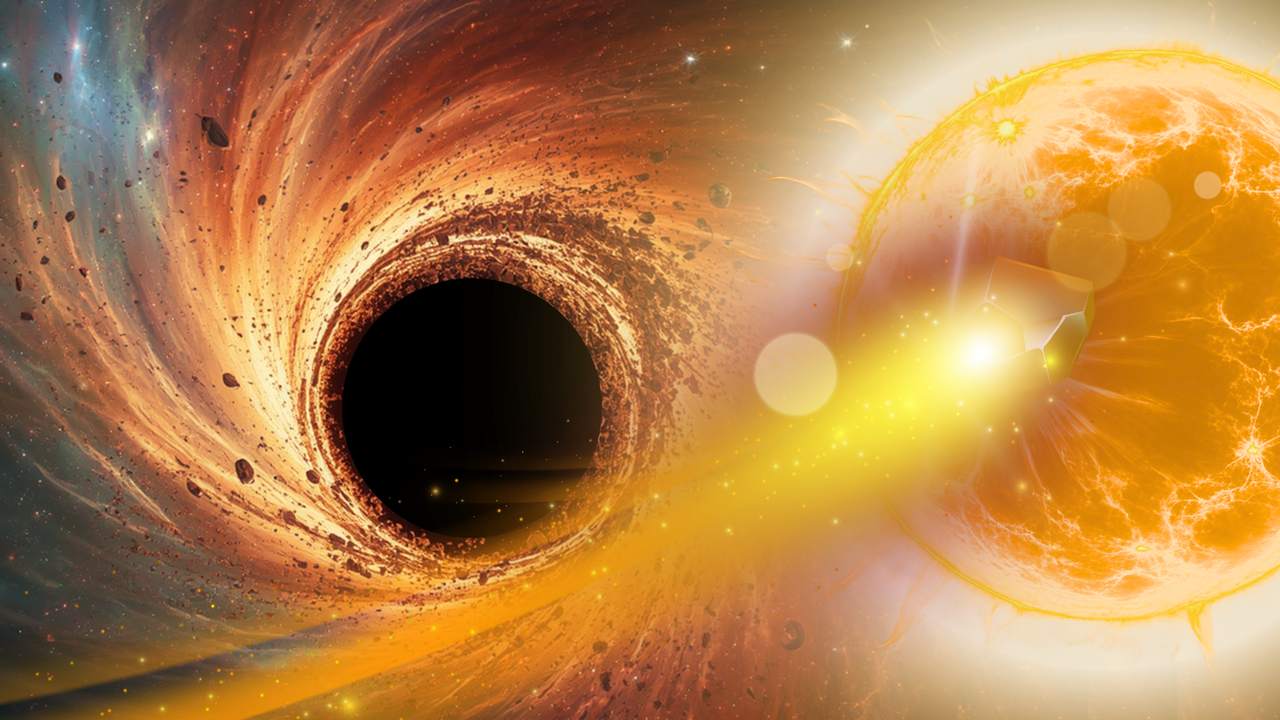
NASA's Nancy Grace Roman Space Telescope will launch August 30 with a powerful new capability: detecting black holes in the act of tearing apart and consuming stars across cosmic time, including during the universe's peak era of star formation known as cosmic noon.
The Roman telescope represents a leap forward in observational astronomy. Its wide field of view and infrared sensitivity will detect tidal disruption events, the violent encounters that occur when stars wander too close to supermassive black holes. These catastrophic interactions produce intense flares as stellar material heats to millions of degrees before crossing the event horizon.
Current telescopes struggle to detect these events consistently, especially at great distances. Roman's capabilities will change that equation. The telescope can observe a much larger patch of sky simultaneously while maintaining sensitivity to the infrared radiation these events emit. This combination allows astronomers to survey vast cosmic volumes and catch tidal disruption events that previous instruments would miss.
The significance lies in understanding black hole behavior across cosmic history. Tidal disruption events serve as cosmic laboratories where researchers can study black hole physics, accretion mechanics, and the environments around supermassive black holes. Roman's observations will reveal how often these events occur at different epochs and what conditions trigger them.
Cosmic noon, roughly 2 to 3 billion years after the Big Bang, represents a golden age when galaxies formed stars at rates never matched before or since. Black holes were also rapidly feeding during this era. Roman will penetrate this dusty period with infrared observations, revealing black hole activity hidden from visible-light telescopes.
The Nancy Grace Roman Space Telescope, named after the pioneering astronomer who invented a technique to measure distances to other galaxies, carries a 2.4-meter primary mirror. NASA developed this observatory specifically to tackle mysteries of dark energy, exoplanet detection, and black hole physics.
The August 30