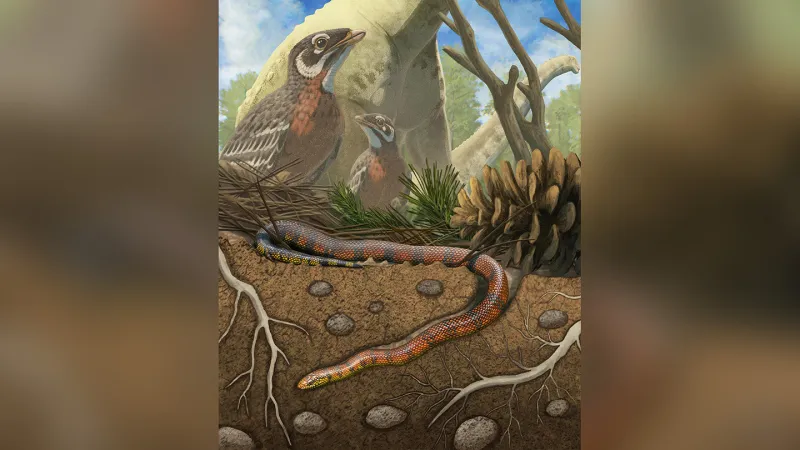
Paleontologists have discovered a rare three-dimensional snake fossil that reveals early snakes possessed far greater anatomical diversity than previously understood. The specimen showcases an unusual head structure adapted for burrowing, expanding scientific knowledge of how snakes evolved and occupied ecological niches millions of years ago.
The fossil preserves detailed cranial anatomy in three dimensions, a rarity in snake paleontology where most specimens appear flattened in rock. This preservation quality allowed researchers to examine features invisible in compressed fossils. The head design differs markedly from modern snake skulls, with specialized adaptations suited for underground life rather than surface hunting or aquatic pursuit.
The unusual anatomy includes modifications to the jaw structure and cranial bones that would have facilitated movement through soil and sediment. These features indicate the animal employed different feeding and locomotion strategies than its contemporaries. Early snake evolution produced forms occupying ecological roles far more varied than living snakes demonstrate today.
The discovery challenges existing hypotheses about snake diversification. Conventional models suggested early snakes developed relatively uniform body plans, with major anatomical variation appearing later in their evolutionary history. This burrowing species demonstrates that snakes experimented with specialized adaptations much earlier than thought.
Three-dimensional snake fossils remain exceptionally rare because most ancient snakes fossilized in sediments that compressed them flat over geological time. Mineralization or rapid burial in specific conditions allows preservation of depth and fine structural details. Each such discovery provides disproportionate insight into extinct snake biology and behavior.
The find underscores how incomplete the fossil record remains. Many snake species likely existed without leaving any trace in rock layers. This specimen represents just one preserved member of an ancient community containing countless undiscovered forms. Future excavations in similar geological formations may yield additional three-dimensional remains that further illuminate how early snakes colonized diverse habitats and lifestyle strategies.