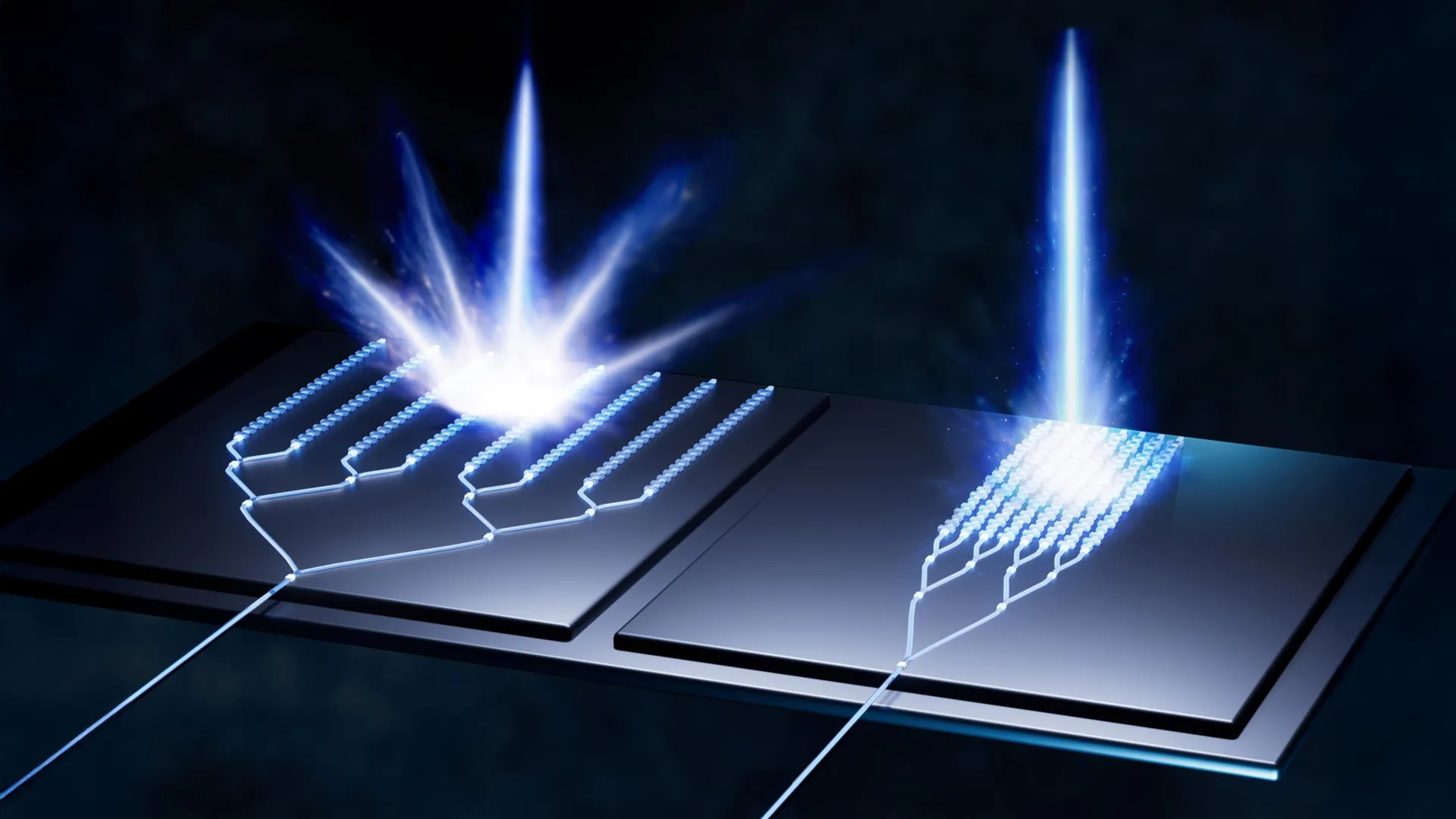
MIT engineers have developed a chip-based lidar system that achieves wide-angle sensing without mechanical moving parts, addressing a major obstacle in autonomous vehicle perception technology.
The researchers designed antennas with varied geometries that can be densely packed on a chip while maintaining signal clarity. This approach eliminates the interference problems that typically plague compact lidar systems. Traditional chip-based lidar struggles with "crosstalk," where signals from adjacent antennas contaminate each other, degrading image quality and range measurements. The MIT team solved this by spacing antennas at different distances from the chip's edge, allowing each antenna to transmit and receive signals without interference from neighbors.
In testing, the system successfully steered a single, focused beam across a broad field of view while significantly reducing signal degradation. This matters because lidar forms the backbone of autonomous vehicle sensing, providing precise 3D maps of surroundings by measuring laser light reflections. Current automotive lidar relies on mechanical scanning mirrors or moving components that add bulk, weight, and cost. Solid-state lidar chips promise cheaper, more reliable alternatives, but scaling them has proven difficult.
The MIT approach represents a step toward practical solid-state lidar that could work at production scale. By eliminating moving parts, the system becomes more durable and potentially more affordable than existing solutions. The design also consumes less power than systems requiring mechanical actuation.
However, the work remains in early stages. The researchers conducted lab tests under controlled conditions, and real-world autonomous driving demands performance across varying weather, lighting, and traffic scenarios. The system must also match the range and resolution of current mechanical lidar systems before manufacturers adopt it widely.
The findings emerge from MIT's broader effort to miniaturize and solidify lidar technology. This research indicates the path forward for next-generation self-driving car sensors that balance performance with manufacturability.