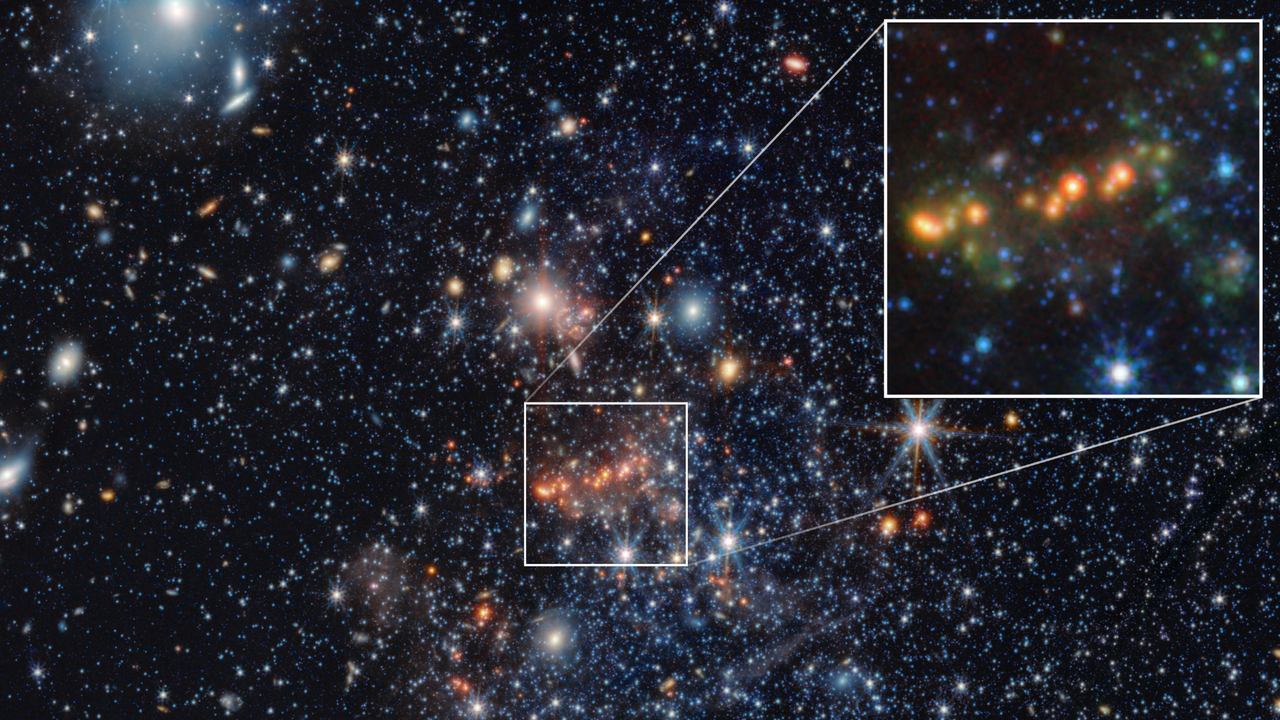
Astronomers using the James Webb Space Telescope have identified how early galaxies manufactured cosmic dust that filled the young universe. The research team studied a nearby modern galaxy as a proxy to understand dust production mechanisms in distant, ancient galaxies from the early cosmos.
The discovery addresses a long-standing puzzle in astronomy. The infant universe contained far more dust than current models predicted possible. Early galaxies should not have generated sufficient dust in the time available, yet observations consistently revealed substantial dust quantities in the first billion years after the Big Bang.
By examining a closer contemporary galaxy with similar properties to those early systems, the researchers reverse-engineered the dust production process. This approach allowed them to observe dust formation mechanisms in detail that would be impossible to resolve directly in distant ancient galaxies. The local galaxy functioned as an analog, revealing how its ancient counterpart likely operated.
Dust plays a fundamental role in cosmic evolution. It absorbs ultraviolet light from stars, re-radiates it as infrared radiation, and provides the raw material for planet formation. Understanding how quickly early galaxies produced dust constrains models of galaxy formation and chemical enrichment in the universe's first epochs.
The James Webb Space Telescope's infrared sensitivity proved essential for this work. Its ability to detect faint infrared emissions from dust allowed astronomers to trace dust production across different stellar populations and identify which types of stars contributed most significantly to cosmic dust budgets.
This research illustrates a common astronomical strategy. When direct observation of distant objects proves difficult, astronomers study nearby analogs with comparable properties. The local galaxy, though billions of years younger than its ancient counterpart, presumably operates under similar physical principles, making it a valuable laboratory for understanding cosmic history.
The findings refine our understanding of how galaxies transformed the universe from a dust-poor environment into the dust-rich cosmos we observe today. This work paves the way for future observations of genuine early galaxies