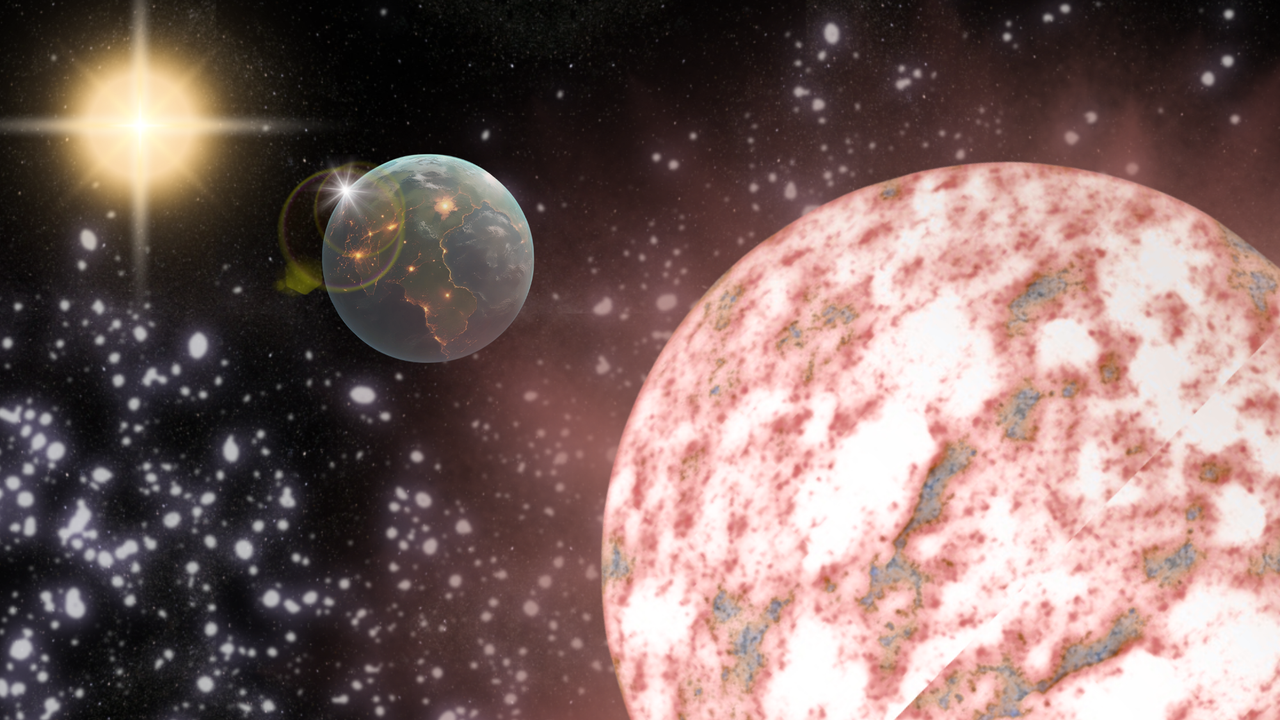
Astronomers have detected unusual gravitational signals from a system located about 8,000 light-years away that could represent the first confirmed exomoon, or an object that fundamentally challenges how scientists classify planets and their satellites.
The detection comes from observations of a star system analyzed through gravitational lensing, a technique where massive objects bend light from distant sources. Researchers noticed gravitational anomalies that don't align neatly with current exoplanet models. The signatures suggest either a moon orbiting an exoplanet or something entirely different from anything observed before.
If confirmed as an exomoon, the discovery would mark a watershed moment in planetary science. Astronomers have identified thousands of exoplanets but have struggled to spot moons around them due to the extreme distances involved and the difficulty of detecting such small objects. An exomoon would require a unique configuration: a moon massive enough to create detectable gravitational effects while remaining bound to its host planet across vast cosmic distances.
However, the data presents a puzzle. The object's characteristics don't fit neatly into established definitions of what constitutes a moon versus a planet. Some researchers propose the anomaly could represent a rogue planet-moon binary system, a planetary system unlike anything in our solar neighborhood, or even an object that existing classification systems simply don't accommodate.
The uncertainty reflects genuine limits in current astronomical methods. Gravitational lensing observations rely on mathematical modeling, and multiple scenarios can produce similar signals. Confirming the discovery requires additional observations and independent verification from other research groups.
The findings highlight how exoplanet science continues pushing against theoretical frameworks developed from our solar system alone. As detection methods improve, astronomers expect to find systems more diverse than those orbiting Earth's sun. This discovery, whether it proves to be an exomoon or something entirely unexpected, demonstrates how observations beyond our cosmic neighborhood reshape fundamental planetary science