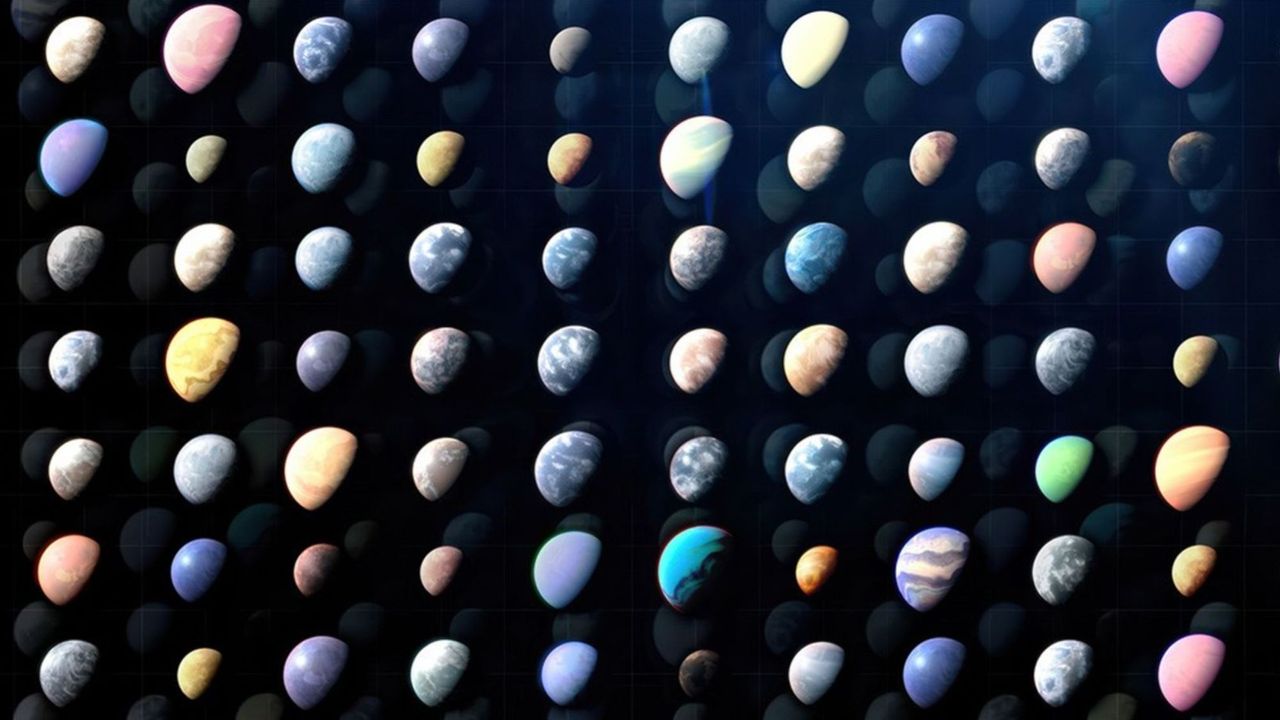
Researchers have determined that exoplanets smaller than Mars probably cannot retain atmospheres long enough to support life. The finding narrows the search space for biosignatures beyond Earth.
A planet's ability to hold an atmosphere depends on its mass and gravity. Smaller worlds lose atmospheric gases to space more readily than larger ones. Mars, with roughly half Earth's diameter, represents an apparent threshold. Planets beneath this size shed their atmospheres too quickly for biological processes to establish themselves, according to the analysis.
The research builds on decades of planetary science showing that atmospheric escape scales with a world's gravitational pull. Lighter gases like hydrogen and helium vanish first, but over time, even heavier molecules drift away. This process accelerates on smaller bodies with weaker gravity fields.
The implications affect how astronomers prioritize exoplanet observations. Surveys searching for biosignatures in distant planetary atmospheres have focused on rocky worlds, but this work suggests scientists should concentrate on planets comparable to Mars or larger. Smaller rocky exoplanets, while potentially numerous, likely lack the atmospheric stability life requires.
The study provides quantitative constraints on habitability, complementing existing models that consider factors like stellar radiation, water availability, and orbital position. It refines what scientists mean by the "habitable zone" around distant stars.
However, limitations remain. The analysis assumes life requires atmospheric conditions similar to Earth's. Alternative biochemistries or subsurface organisms might persist on smaller worlds without substantial atmospheres. Additionally, the calculations depend on atmospheric composition assumptions that may not apply universally.
The research reflects ongoing efforts to place life in cosmic context. As space telescopes like the James Webb Space Telescope detect exoplanet atmospheres with increasing sensitivity, knowing which worlds merit detailed study becomes essential. By filtering candidates based on planetary mass, astronomers can focus resources on targets with the highest probability of detectable life.
CATEGORY