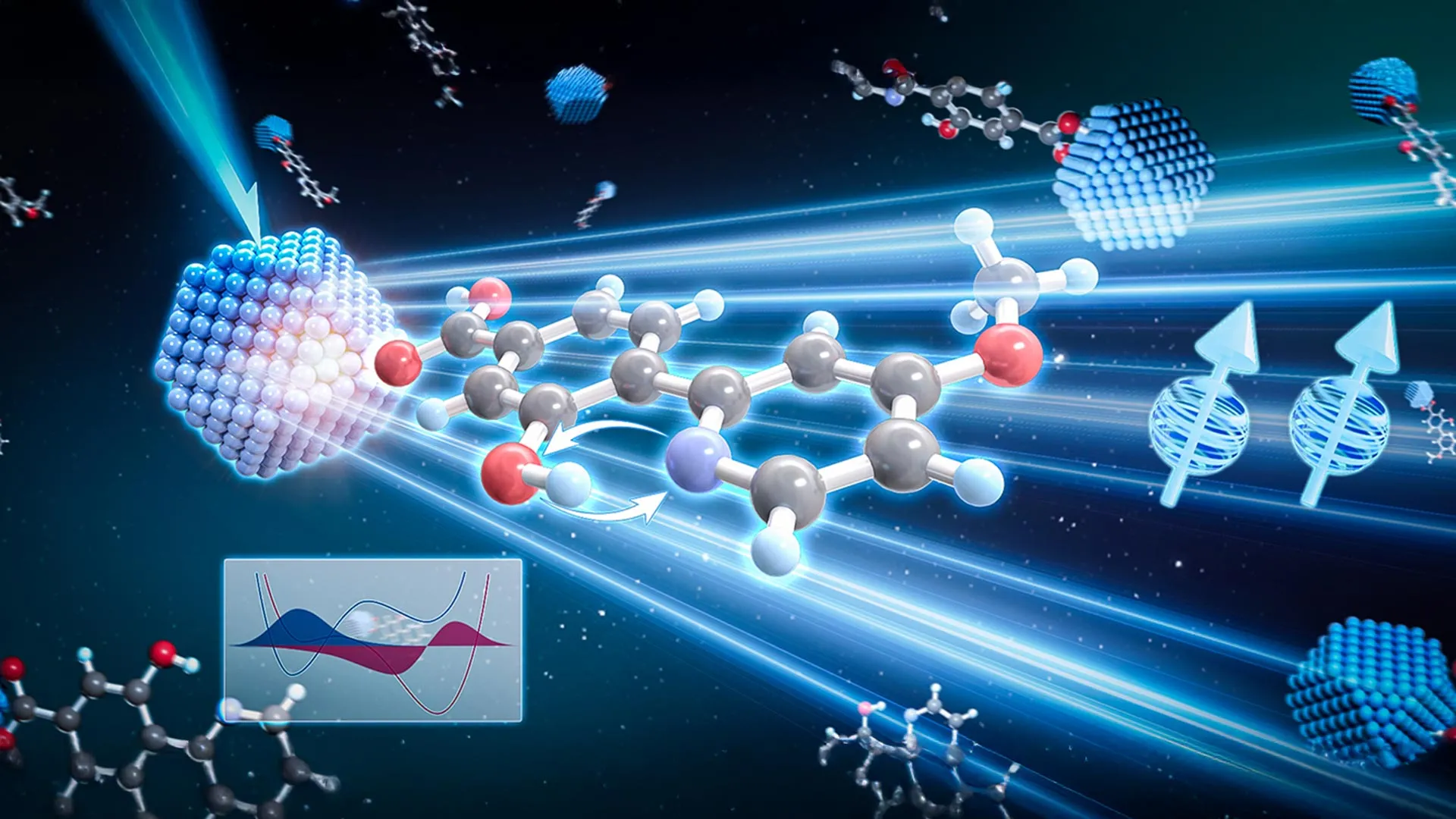
Researchers have identified a quantum mechanism involving protons that dramatically accelerates energy transfer between quantum dots and neighboring molecules. The process works through a proton-shuttle effect, where a proton temporarily displaces, facilitates electron coordination, and returns to its original position.
This discovery centers on triplet energy transfer, a fundamental process in photovoltaic and photochemical systems. Quantum dots are nanoscale semiconductors that absorb and emit light with exceptional precision. The team found that when a proton briefly moves within the molecular structure near a quantum dot, it creates favorable conditions for energy to flow more efficiently to adjacent molecules.
The proton acts as a quantum intermediary. During the transfer event, the proton shifts position to help align electron orbital pathways between the quantum dot and the target molecule. Once electron transfer occurs, the proton snaps back to its original location, completing the cycle. This dynamic rearrangement happens on femtosecond timescales and represents a previously uncharacterized form of energy coupling.
The researchers tested this mechanism using spectroscopic techniques that track energy movement in real time. By monitoring how triplet excitons move from quantum dots to acceptor molecules, they observed energy transfer rates substantially higher than classical models predicted. The enhancement occurred specifically when protons could move freely within the system.
The implications span multiple fields. Solar cell developers could employ this proton-assisted mechanism to boost photon-to-electron conversion efficiency. Laser manufacturers might exploit it to improve light amplification. Catalysis researchers could harness the effect to accelerate chemical reactions in industrial processes.
However, the mechanism requires specific chemical environments where proton mobility remains high. Performance depends on the precise geometry of molecular arrangements around each quantum dot. Temperature, solvent composition, and pH all influence proton availability and positioning. Future work must map these dependencies systematically.
The team plans to engineer quantum dot