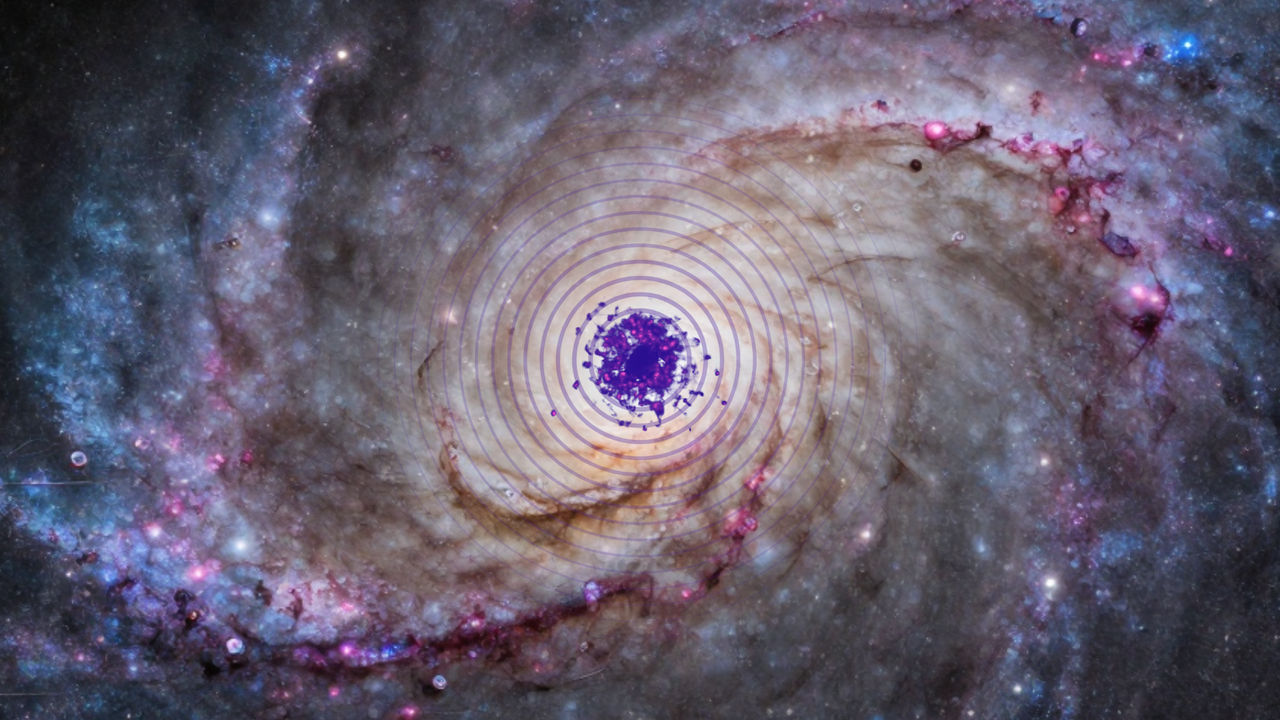
Physicists exploring the connection between two of cosmology's deepest puzzles now propose that dark matter and extra dimensions may be fundamentally intertwined.
The research examines whether dark matter, the invisible substance comprising roughly 85 percent of the universe's matter, could originate from or interact with spatial dimensions beyond the three we perceive. This theoretical framework attempts to address why dark matter has eluded direct detection despite decades of experimental searches and why extra dimensions, predicted by string theory and other unified physics models, remain unobserved.
The connection rests on a straightforward premise. If dark matter particles exist in higher dimensions, they would naturally appear invisible to our standard three-dimensional instruments and detectors. Their gravitational effects would register as the familiar galactic rotation curves and gravitational lensing astronomers observe, yet the particles themselves would remain hidden behind dimensional boundaries.
This approach offers potential solutions to persistent problems in particle physics. Standard dark matter candidates like WIMPs (weakly interacting massive particles) have produced null results in underground detection experiments. Kaluza-Klein particles, which emerge naturally when extending known physics into higher dimensions, represent viable alternatives. These theoretical particles would exhibit precisely the properties dark matter appears to possess: minimal interaction with ordinary matter and significant gravitational influence.
The hypothesis does not rely on any revolutionary new physics. Instead, it combines existing theoretical frameworks that mainstream physicists already accept as plausible. String theory predicts 10 or 11 dimensions. Extra spatial dimensions appear in several grand unification theories. Dark matter's gravitational signatures remain consistently documented across cosmic observations.
However, significant barriers remain. Direct evidence for higher dimensions does not exist. Proving dark matter originates from or travels through extra dimensions requires experimental methods scientists have not yet developed. The proposal remains speculative, dependent on assumptions about dimensions we cannot currently access or measure.
Testing these ideas will require advances in particle