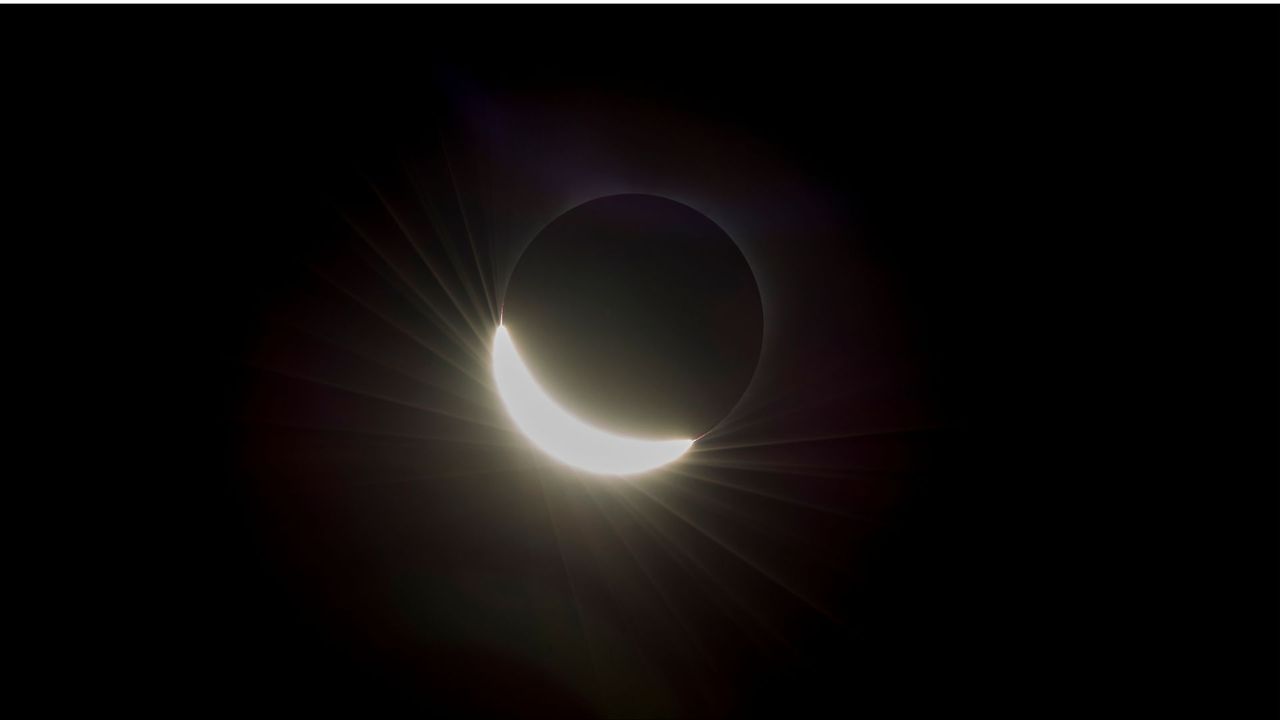
A total solar eclipse will cross Valoria la Buena on August 12, marking a long-awaited astronomical event for observers in this location. The eclipse represents a rare celestial alignment where the Moon passes directly between Earth and the Sun, casting a shadow across a narrow path on the planet's surface.
Total solar eclipses occur when the Moon's apparent size matches the Sun's in Earth's sky, allowing the lunar disk to completely block the Sun's photosphere. This alignment happens roughly every 18 months somewhere on Earth, but any given location experiences one only once every 300 to 400 years on average. The interval depends on orbital mechanics and Earth's geography.
During totality, observers in the eclipse path witness the Sun's corona, its outermost atmosphere, which remains invisible during normal daylight. The corona reveals intricate structures of plasma and magnetic fields extending millions of kilometers into space. The sudden darkness at midday allows stars and planets to become visible and causes temperature drops of up to 10 degrees Fahrenheit.
Eclipse chasers travel thousands of miles to experience totality, which typically lasts two to seven minutes depending on the observer's location within the path. The narrow corridor of totality, usually 100 to 200 kilometers wide, contrasts sharply with the partial eclipse visible across a much broader region.
Scientific observations during total solar eclipses have advanced understanding of solar physics. During the 1919 eclipse, Arthur Eddington's measurements of starlight bending near the Sun provided early confirmation of Einstein's general relativity theory. Modern eclipse observations continue measuring the Sun's corona and studying phenomena like coronal heating, where the corona remains hotter than the Sun's surface.
For individuals anticipating this August event, the experience combines scientific value with personal significance. The rarity of witnessing totality from a specific location creates urgency among eclipse enthusiasts