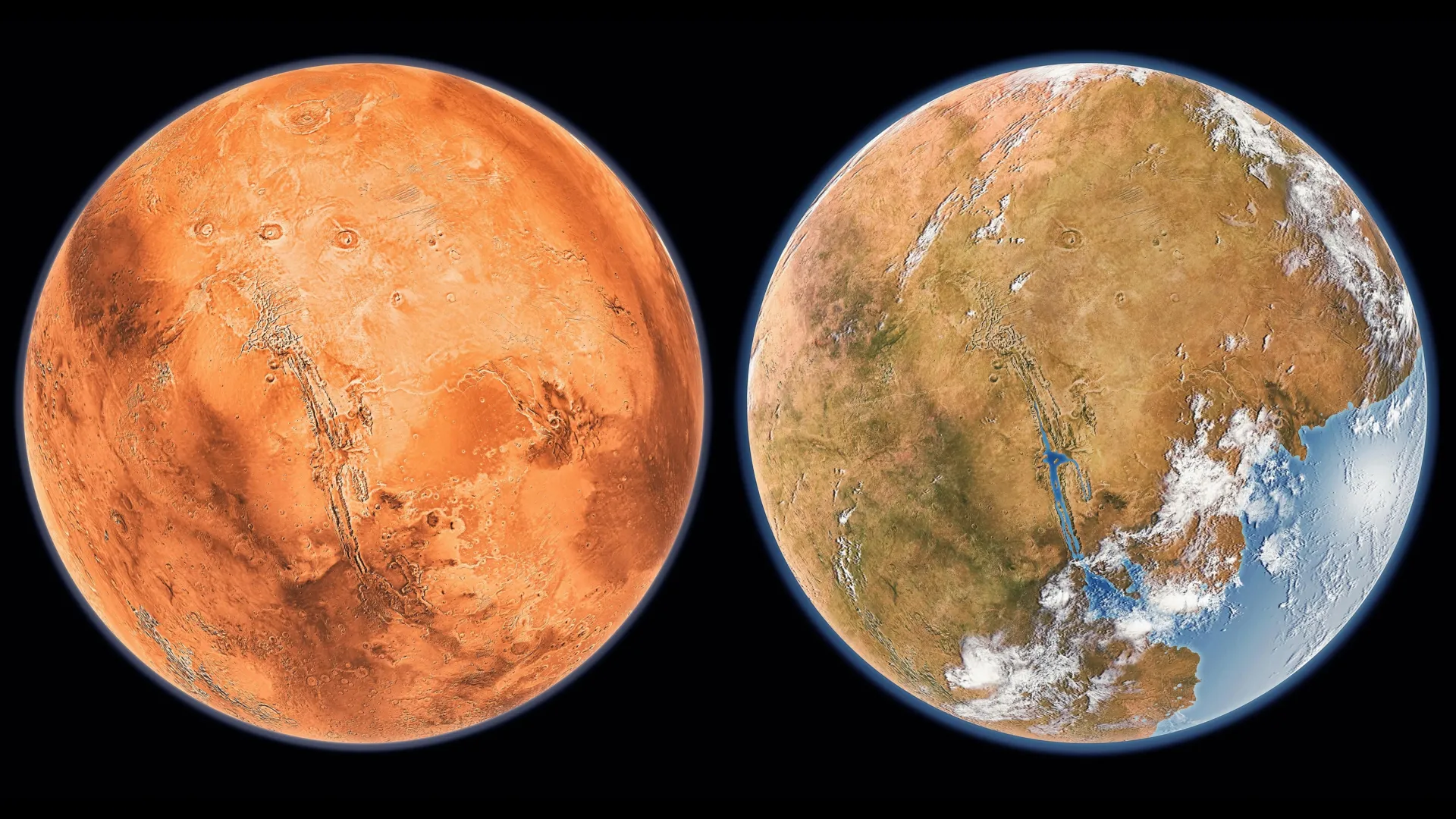
Scientists have revived serious consideration of terraforming Mars, arguing that emerging technologies make the once-dismissed concept worth studying as a genuine scientific endeavor rather than mere science fiction.
The shift reflects advances in engineering and materials science that could theoretically enable humans to modify Mars's atmosphere, temperature, and surface conditions to support life. Researchers emphasize that this transition from speculative fantasy to active research agenda demands careful ethical and scientific analysis before any terraforming attempts begin.
A central concern occupies planetary scientists: whether Mars already contains life. If microbial organisms exist in subsurface aquifers or beneath the polar ice caps, terraforming could contaminate or destroy native Martian biology. Such an outcome would erase the opportunity to study the only known example of life emerging independently from Earth. The risk cuts both ways, researchers note. Introducing Earth microorganisms to Mars could also corrupt any Martian biosphere and create unpredictable ecological consequences.
The debate encompasses practical obstacles alongside ethical ones. Mars lacks a protective magnetic field, allowing solar wind to strip away any artificial atmosphere researchers might create. The planet's thin current atmosphere makes initial terraforming extremely slow. Yet proponents argue that technologies like orbital mirrors to concentrate sunlight, synthetic greenhouse gases to warm the planet, and genetically modified organisms to produce oxygen represent viable pathways that warrant serious investigation.
Researchers stress that understanding these challenges and risks must precede any action. Several scientific institutions have begun examining the biological, geological, and technological dimensions of potential terraforming. This represents a genuine shift from dismissal toward methodical analysis.
The timeframe remains distant. Most experts acknowledge that meaningful terraforming would require centuries. Yet by treating the concept as legitimate science requiring rigorous examination, researchers have elevated the conversation beyond speculation. The focus now centers on what needs to be learned, tested, and decided before humanity possesses the capability to reshape another world.