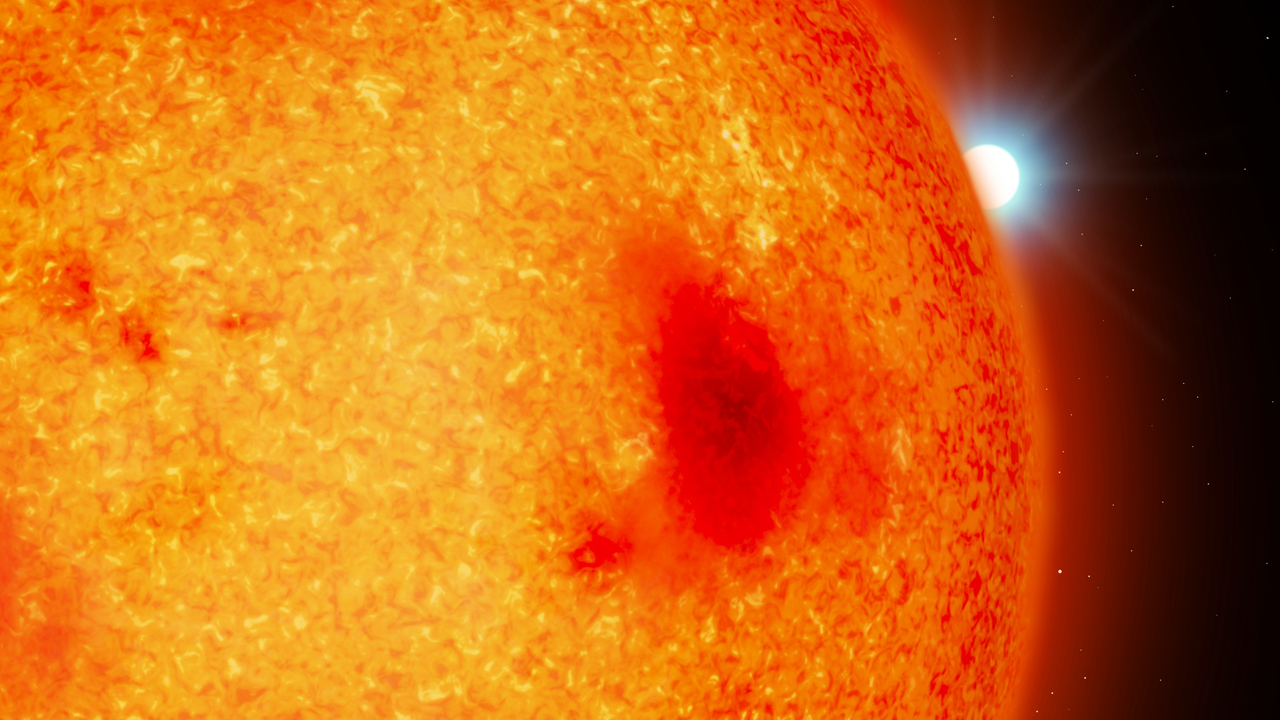
Astronomers have discovered four white dwarfs lurking in binary star systems with red dwarfs, invisible to direct observation because their companion stars outshine them. The white dwarfs remained hidden despite their extreme density, each containing the mass of our Sun compressed into an object the size of Earth.
The research team detected these stellar corpses through indirect methods, analyzing the gravitational influence they exert on their red dwarf partners. White dwarfs represent the final evolutionary stage of stars like our Sun, formed after they exhaust their nuclear fuel and shed their outer layers. Their immense gravity and heat make them normally bright and relatively easy to identify, but when paired with active red dwarfs, the smaller companion's light overwhelms the white dwarf's signature.
Scientists found these systems by studying the orbital dynamics of the red dwarfs. The gravitational pull from the invisible white dwarfs causes measurable wobbles in the red dwarfs' positions and velocities. Researchers measured these perturbations using spectroscopic data and astrometric observations, allowing them to infer the presence and mass of the hidden white dwarfs without seeing them directly.
The discovery expands the known population of white dwarfs in our galactic neighborhood and suggests more such hidden systems likely exist. Red dwarf-white dwarf pairs offer laboratories for studying stellar evolution and mass transfer processes. When white dwarfs pull material from red dwarfs, intense nuclear reactions can occur on their surfaces, occasionally producing thermonuclear explosions called Type Ia supernovae, which astronomers use as cosmic distance markers.
The research demonstrates how modern observational techniques detect objects invisible to telescopes. Rather than relying solely on direct light detection, astronomers combine astrometry, spectroscopy, and gravitational analysis to map the cosmos' hidden architecture. These four systems add crucial data for understanding how binary evolution shapes stellar populations,