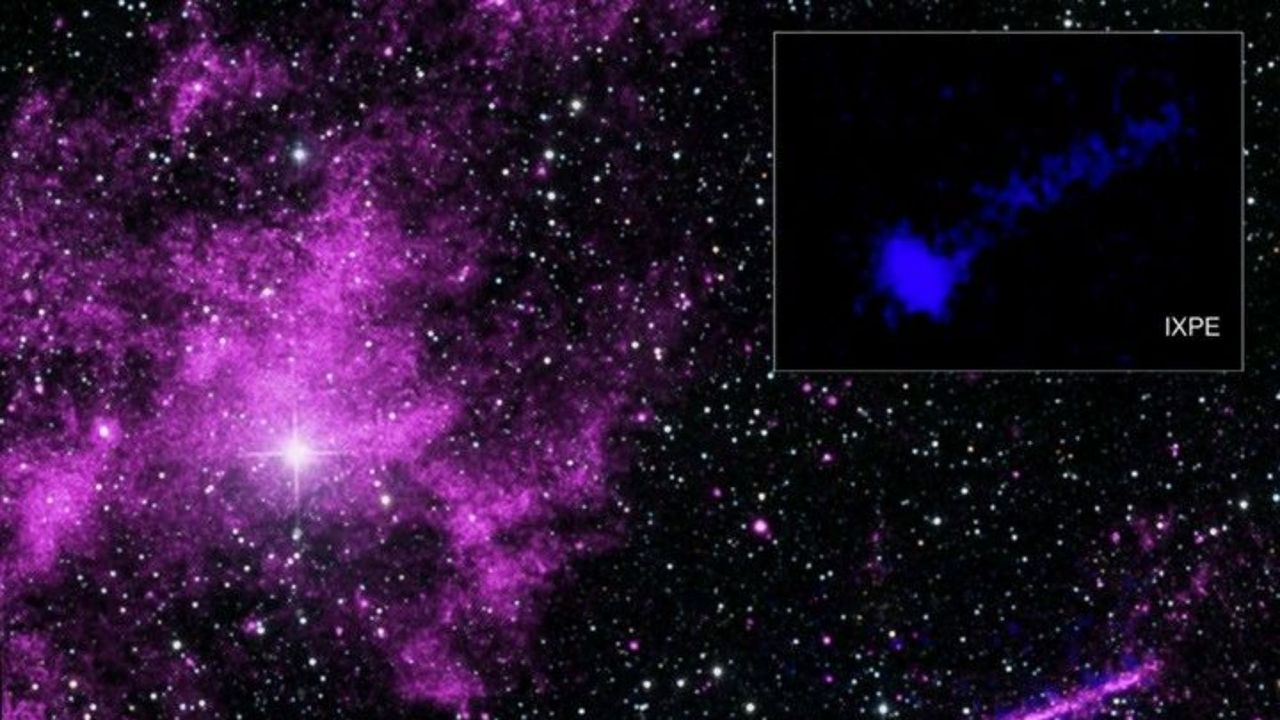
Astronomers have directly mapped the magnetic field around an unusual pulsar in the Milky Way for the first time, confirming theoretical predictions about how charged particles escape from the rapidly rotating neutron star.
The research team used observations to trace the magnetic structure surrounding the pulsar, revealing the pattern of particle emission that astrophysicists had predicted decades earlier but never directly observed before. Pulsars are dense remnants of dead stars that spin at extreme speeds, emitting radiation like cosmic lighthouses. This particular pulsar stands out for its unusual properties compared to typical pulsars in our galaxy.
The direct mapping provides crucial validation of decades-old models describing how the intense magnetic fields around these objects channel and accelerate particles away from the neutron star's surface. The charged particles follow the magnetic field lines in a specific geometry, creating the streaming pattern the team detected.
The observation represents a major step in understanding pulsar physics and the extreme environments surrounding neutron stars. Previous studies relied on indirect evidence and mathematical models to infer magnetic field structures. This direct measurement allows researchers to test whether current theoretical frameworks accurately describe real pulsars.
The finding also carries broader implications for astrophysics. Pulsars serve as natural laboratories for studying physics under conditions impossible to recreate on Earth. Magnetic fields in these objects reach strengths billions of times stronger than anything humans can produce. Understanding how particles behave in such extreme magnetized environments informs research across multiple fields, from particle physics to understanding cosmic radiation.
The team's methodology could enable similar direct mappings of other unusual pulsars. Future observations using advanced radio telescopes and other instruments should reveal magnetic field structures around additional neutron stars, expanding the sample of directly measured pulsar magnetospheres and testing whether theoretical models hold across different pulsar types.