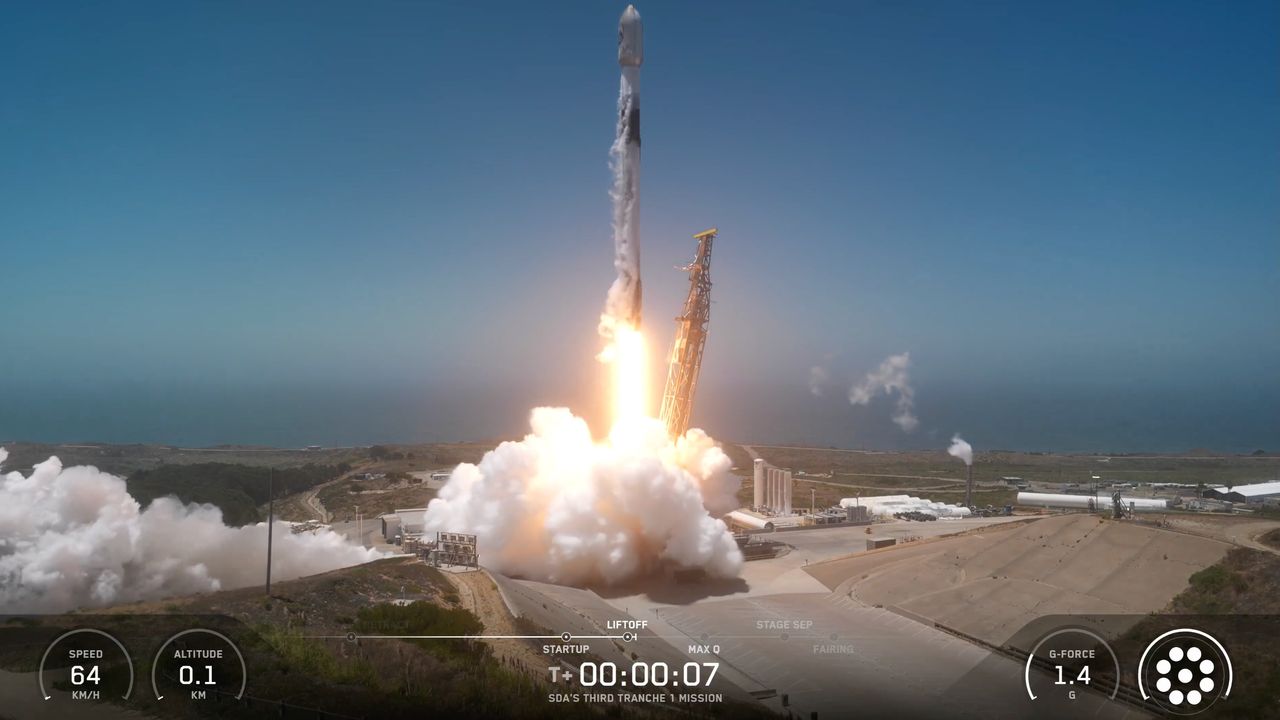
SpaceX launched 21 satellites for the U.S. military on July 16 from California's central coast as part of the Pentagon's advanced "Tranche 1 Transport Layer" constellation. The mission expands the military's growing network of orbital data relay spacecraft designed to connect ground forces, ships, and aircraft with secure, high-speed communications.
The Transport Layer represents a shift in how the Department of Defense approaches military communications. Rather than relying on a single constellation of massive, expensive satellites, the Pentagon is building a resilient mesh of smaller, interconnected spacecraft. This distributed approach reduces vulnerability to attacks and provides redundancy if individual satellites fail.
SpaceX has conducted multiple launches for this program since its inception. The company uses its Falcon 9 rocket for these dedicated military missions. Each launch incrementally adds capacity to the network, bringing the total constellation closer to full operational capability.
The Transport Layer satellites operate in low Earth orbit, enabling lower latency communications compared to traditional geosynchronous military satellites. Lower latency means faster data transmission, critical for real-time battlefield coordination and decision-making. The constellation allows direct links between satellites rather than routing all signals through ground stations.
The U.S. Space Force oversees the Transport Layer program as part of its broader modernization strategy. The military characterizes the constellation as resilient and disaggregated, terms emphasizing its ability to maintain operations even if adversaries target individual satellites or ground infrastructure.
SpaceX competes with other contractors on Department of Defense contracts. The company has won multiple launch awards for military space missions, reflecting its competitive pricing and reliable launch cadence. The Falcon 9's reusability contributes to lower costs compared to expendable launch vehicles.
The Transport Layer constellation remains under development, with additional planned launches scheduled through the coming years. Full deployment will create a network spanning multiple orbital planes, enhancing coverage over