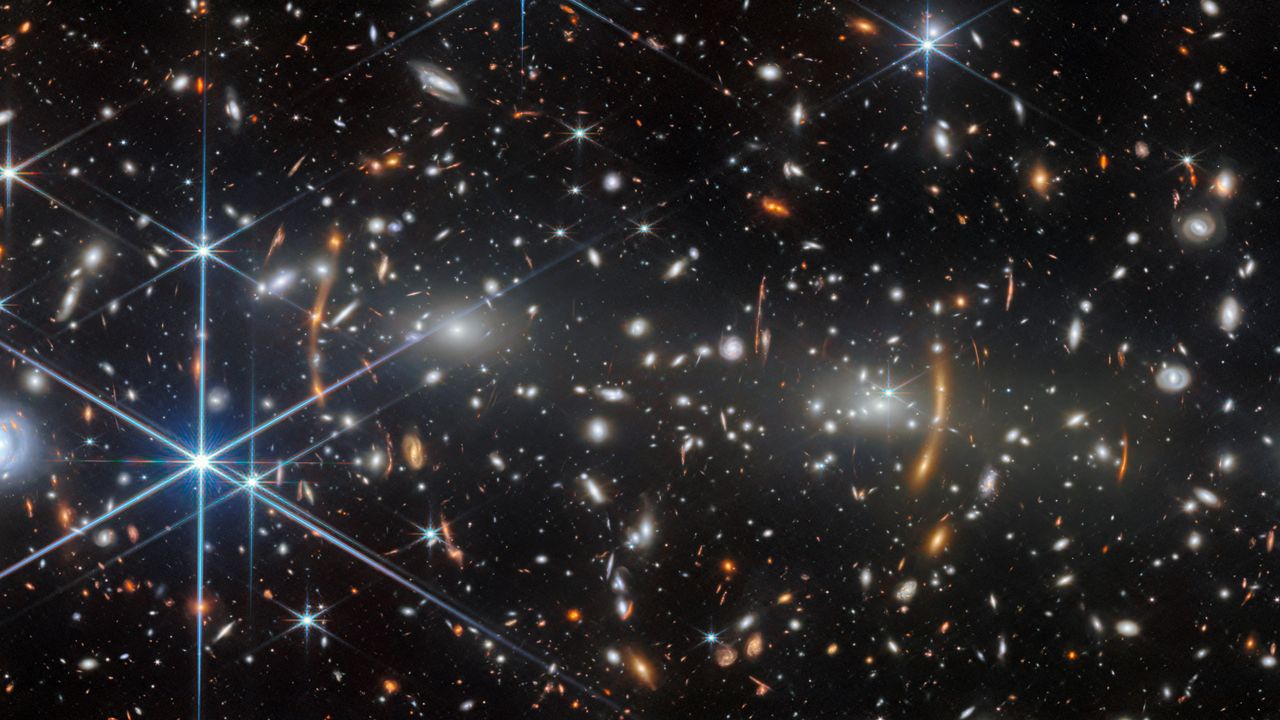
The James Webb Space Telescope has employed gravitational lensing, a phenomenon predicted by Albert Einstein's general theory of relativity, to observe some of the universe's most distant galaxies. This technique allows astronomers to study galaxies formed during the first billion years after the Big Bang, a period otherwise difficult to access with current observational technology.
Gravitational lensing occurs when massive objects in space warp the fabric of space-time around them. Light from distant galaxies bends as it travels through this warped space, magnifying and distorting the view of background objects. The effect acts like a natural cosmic lens, amplifying light from galaxies too faint and distant for direct observation.
JWST's infrared capabilities make it particularly suited for detecting these lensed galaxies. The telescope observes wavelengths of light that have been redshifted, stretched toward the infrared spectrum due to the expansion of the universe. Combining gravitational lensing with JWST's sensitivity allows researchers to effectively peer backward in time, examining the universe's earliest epochs.
The telescope has used this method to study galaxy formation, stellar populations, and chemical composition in the infant universe. Data from these observations inform models of how galaxies assembled and evolved over cosmic time. Researchers can measure the masses of distant galaxies and determine their star formation rates, details that remain hidden without lensing amplification.
Gravitational lensing observations carry inherent limitations. The alignment between observer, lensing mass, and distant galaxy must be precise. Dust and gas within lensing galaxies can distort observations. Researchers must also account for how the intervening matter affects light during transit.
Despite these constraints, gravitational lensing surveys conducted by JWST continue yielding discoveries about the early universe. Astronomers have identified surprisingly mature galaxies in the early cosmos, challenging previous models of