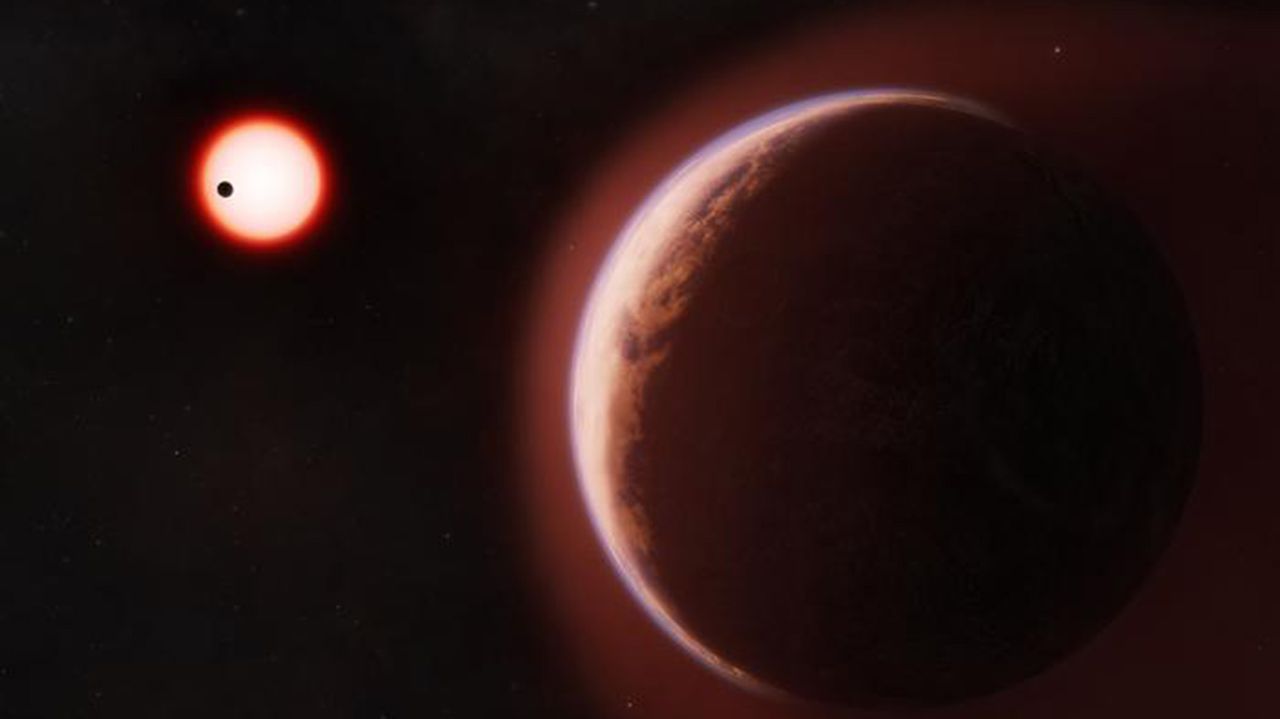
Astronomers detected helium escaping from LHS 1140 b, a super-Earth orbiting in its star's habitable zone. This discovery marks the first time researchers have confirmed an atmosphere around a rocky, potentially habitable exoplanet. The finding appears in peer-reviewed research and carries major implications for understanding which distant worlds might support life.
LHS 1140 b orbits the red dwarf star LHS 1140, located roughly 48 light-years away in the constellation Cetus. The planet sits within the habitable zone, the orbital region where liquid water could exist on a planet's surface. Its mass reaches approximately 6 times Earth's mass, classifying it as a super-Earth, a category of planets absent from our solar system.
The team used spectroscopy to detect helium in the planet's upper atmosphere. When starlight filters through a planet's atmosphere as it passes in front of its host star, certain chemical elements absorb specific wavelengths. By analyzing this absorption pattern, researchers identified helium and traced its escape into space. This atmospheric detection provides the strongest evidence that a rocky exoplanet in a habitable zone has maintained its atmosphere over billions of years.
Retaining an atmosphere represents a critical factor for habitability. Rocky planets lose atmospheres over time through stellar wind bombardment and thermal escape. Most terrestrial exoplanets studied so far have either lost their atmospheres entirely or never developed substantial ones. LHS 1140 b's sustained atmosphere suggests the planet has weathered billions of years of atmospheric loss and retained enough gases to potentially support conditions for life.
The research builds on earlier studies of LHS 1140 b, which identified the planet in 2019. Subsequent observations added detail about its composition and conditions. This latest atmospheric detection opens new avenues for searching for biosignatures on distant worlds.
The