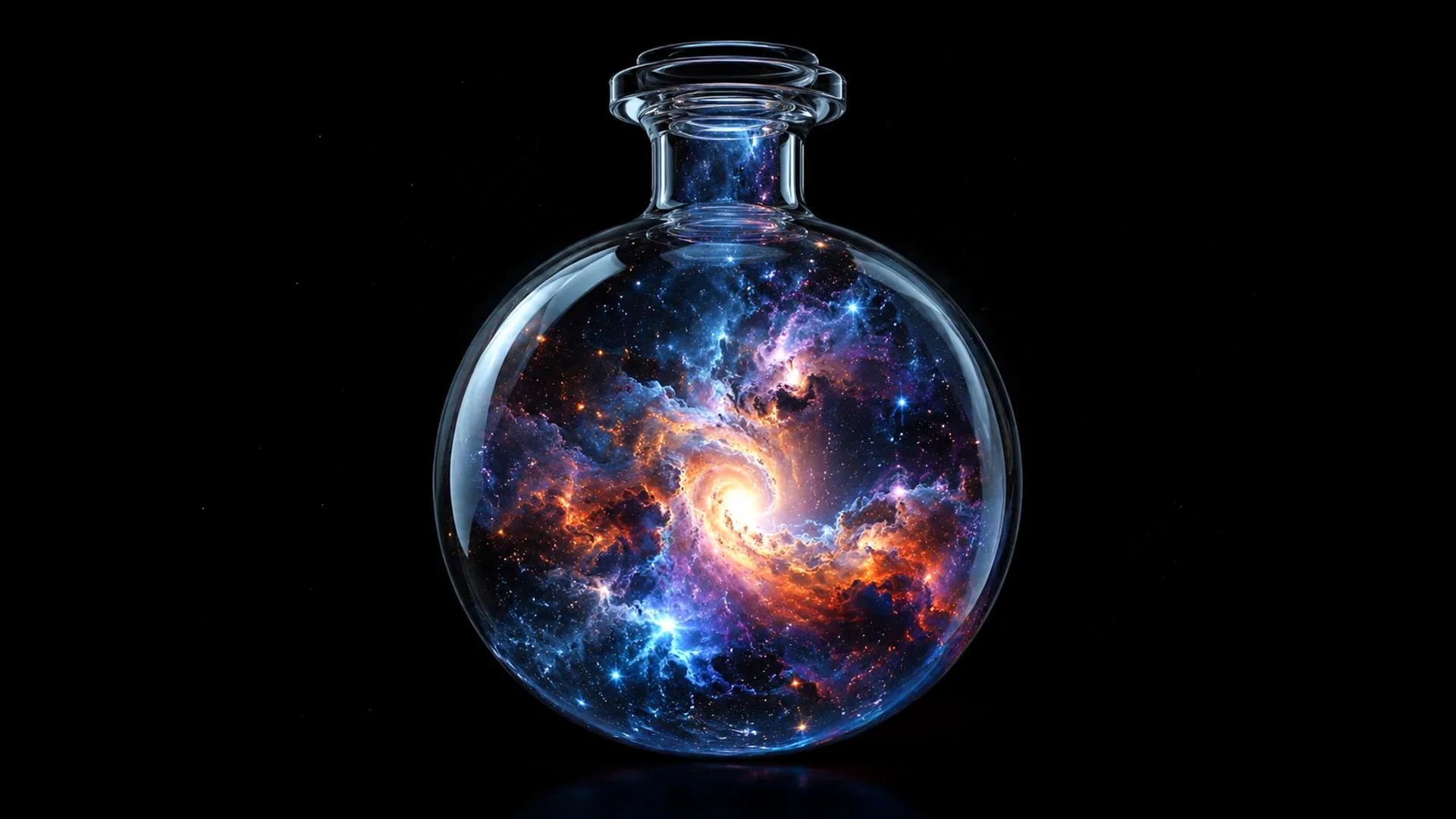
Researchers have synthesized cosmic dust in laboratory glass tubes by mimicking the harsh conditions of space, generating new insights into how life's chemical building blocks form beyond Earth.
The team recreated the extreme environment found around stars, where temperatures plummet and radiation floods through vacuum. Inside the tubes, they built complex carbon-rich molecules from elements critical to biology. carbon, hydrogen, nitrogen, and oxygen combined into structures that emit infrared signals matching those detected from actual cosmic dust collected from meteorites and interstellar surveys.
This work demonstrates that organic chemistry does not require Earth's conditions to emerge. Stars and their surrounding dust clouds naturally synthesize the same molecular complexity found in living things. The laboratory dust serves as a chemical analog, allowing scientists to study reaction pathways that occur in space without traveling there.
The implications extend to planetary origins. Comets, asteroids, and meteorites routinely collide with planets, delivering their payloads of carbon-based compounds. Early Earth received constant bombardment from such objects over hundreds of millions of years. The new experiments suggest that prebiotic chemistry, the set of reactions that preceded life, may have begun with ingredients already present in the solar system's primordial dust.
By analyzing the infrared signatures of their synthetic dust, researchers can now match specific molecular structures to spectral features observed by space telescopes. This connection between laboratory work and astronomical data strengthens confidence in models of chemical evolution across the cosmos.
The study has limits. Laboratory conditions approximate space but cannot capture every variable present in real cosmic environments. Dust chemistry also depends heavily on local factors like stellar radiation intensity, magnetic fields, and density gradients. Experiments cannot simulate the vast timescales or the complex surfaces of dust grains where reactions proceed differently than in gas phase.
Still, the work establishes a concrete bridge between stellar chemistry and life's origins. Future refinements to these experiments may reveal new reaction pathways