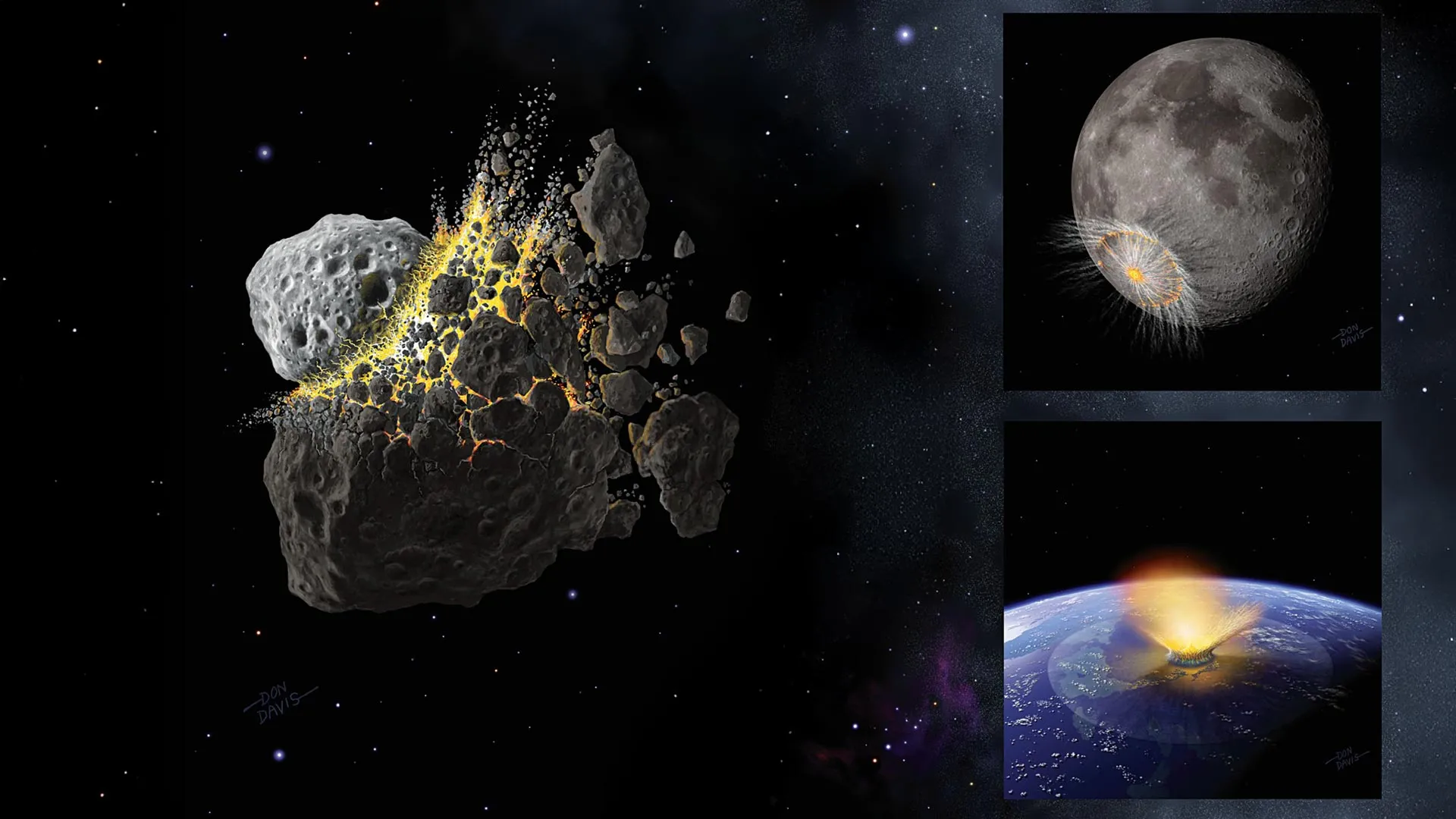
A fragmented asteroid may have unleashed a cascade of impacts across the inner solar system roughly 800 million years ago, according to new research. The breakup occurred near Jupiter's gravitational influence zone, which funneled debris toward Earth, the Moon, and Mars during this period.
The discovery centers on evidence of ancient lunar craters that cluster in ways suggesting a single parent body shattered and sent multiple fragments toward terrestrial planets. Researchers identified this bombardment window by analyzing crater distributions and impact chronologies preserved in the geological record. Jupiter's immense gravitational field acts as a sorting mechanism for asteroid fragments, directing some toward the inner solar system while ejecting others into space.
The timing of this event, approximately 800 million years ago, overlaps with significant changes in Earth's climate and biological systems during the Neoproterozoic era. Major ice ages swept the planet during this period, and complex life forms were diversifying following earlier extinctions. While the connection remains under investigation, the asteroid bombardment could have injected dust and aerosols into the atmosphere, altering solar radiation reaching Earth's surface and triggering or intensifying glaciation cycles.
The research builds on decades of work studying impact cratering and solar system dynamics. Scientists reconstructed the likely trajectory and fragmentation pattern by mapping crater locations on the Moon, where geological preservation is superior to Earth's more active surface. The absence of atmospheric weathering on the Moon provides a clearer record of impact history than terrestrial craters, which erode or disappear through plate tectonics and erosion.
This work illustrates how celestial mechanics can influence planetary evolution. Future studies will focus on matching specific craters to potential parent asteroids and refining estimates of how many fragments struck each body. Understanding these ancient bombardment periods provides context for assessing modern impact risks and recognizing how catastrophic space events have shaped Earth's history.