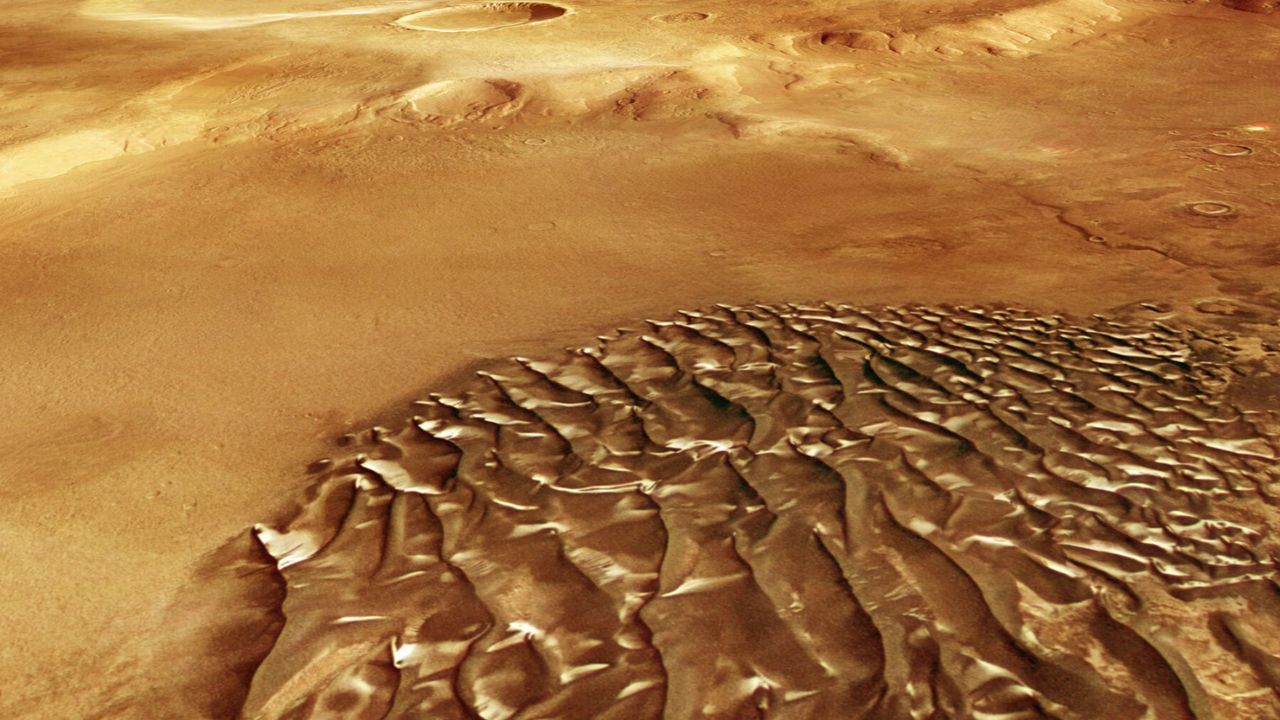
The European Space Agency's Mars Express orbiter has captured unusual wave-like formations on Mars that appear metallic and otherworldly in recent images. These structures, known as dunes, display distinctive patterns that initially caught researchers' attention for their striking visual appearance.
The "metallic" appearance results from how the orbiter's imaging system captures light reflecting off the Martian surface. The dunes exhibit unusual rippling patterns created by wind erosion over millions of years. Martian winds consistently blow across certain regions, sculpting sand and dust into these wave-like ridges. The particular wavelengths captured by Mars Express's cameras emphasize the topographical variations, creating the shimmering, metallic look that sparked public interest.
Scientists studying these formations use them to understand atmospheric circulation patterns and surface composition on Mars. The dune patterns reveal information about wind direction, speed, and consistency across different Martian regions. By analyzing these features, researchers gain insight into how the planet's thin atmosphere interacts with its surface over geological timescales.
Mars Express, launched by the ESA in 2003, continues to provide detailed orbital imagery of the Red Planet after two decades in operation. The orbiter carries multiple imaging instruments designed to map surface features, measure atmospheric properties, and search for subsurface water ice. Its longevity has made it invaluable for long-term monitoring of Martian surface changes.
The images represent routine scientific observations rather than a surprising discovery. Mars hosts billions of dunes across its surface, concentrated in polar regions and scattered throughout lower latitudes. Different dune types, including barchan, linear, and star-shaped formations, indicate varying wind patterns and sand availability. These features have fascinated planetary scientists since early spacecraft missions revealed Mars's complex geology.
Public interest in Mars imagery often focuses on unusual appearances that evoke science fiction imagery. The metallic-looking dunes exemplify how