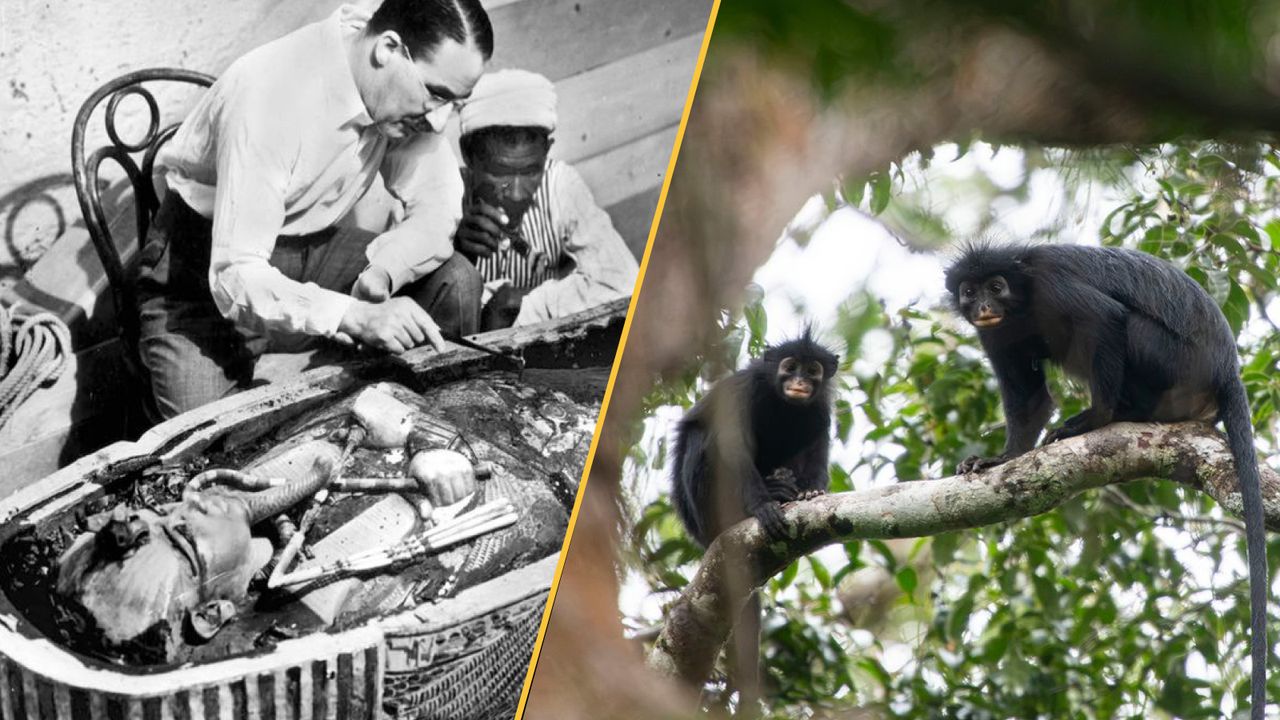
A collection of four discoveries captured scientific attention this week. Archaeologists uncovered gold tongues in ancient tombs, suggesting ritual practices involving precious metals in burial ceremonies. The artifacts reveal how early societies valued gold not just as currency but as sacred objects for the deceased.
Astronomers detected sugar molecules in space, specifically in a molecular cloud region. This finding adds to the growing evidence that organic compounds exist throughout the cosmos, supporting theories about the chemical building blocks available for life's emergence. The discovery was made using radio telescope observations that identified the sugar's spectral signature.
Primatologists identified a new monkey species in the Congolian rainforest. The animal represents a previously unknown member of the primate family and highlights how biodiversity hotspots like Congo still harbor species unknown to science. The discovery underscores the urgent need for rainforest conservation before species disappear before documentation.
An amateur astronomer used geolocation techniques to identify an ancient impact crater. By analyzing satellite imagery and geological features visible in photographs, the amateur scientist pinpointed the crater's location without professional surveying equipment. The find demonstrates how citizen science and accessible satellite data democratize geological discovery.
These stories span archaeology, astronomy, primatology, and geology. They reflect ongoing scientific work across multiple disciplines and the varied methods researchers employ, from radioactive dating in tombs to radio telescope observations in space to visual analysis of satellite imagery. The discoveries also underscore how science remains active across all scales. From the subatomic level studying ancient artifacts to the cosmic scale examining interstellar chemistry, researchers continue expanding human knowledge. The amateur astronomer's success particularly emphasizes that significant contributions come not only from institutional scientists but from dedicated individuals using public resources creatively.