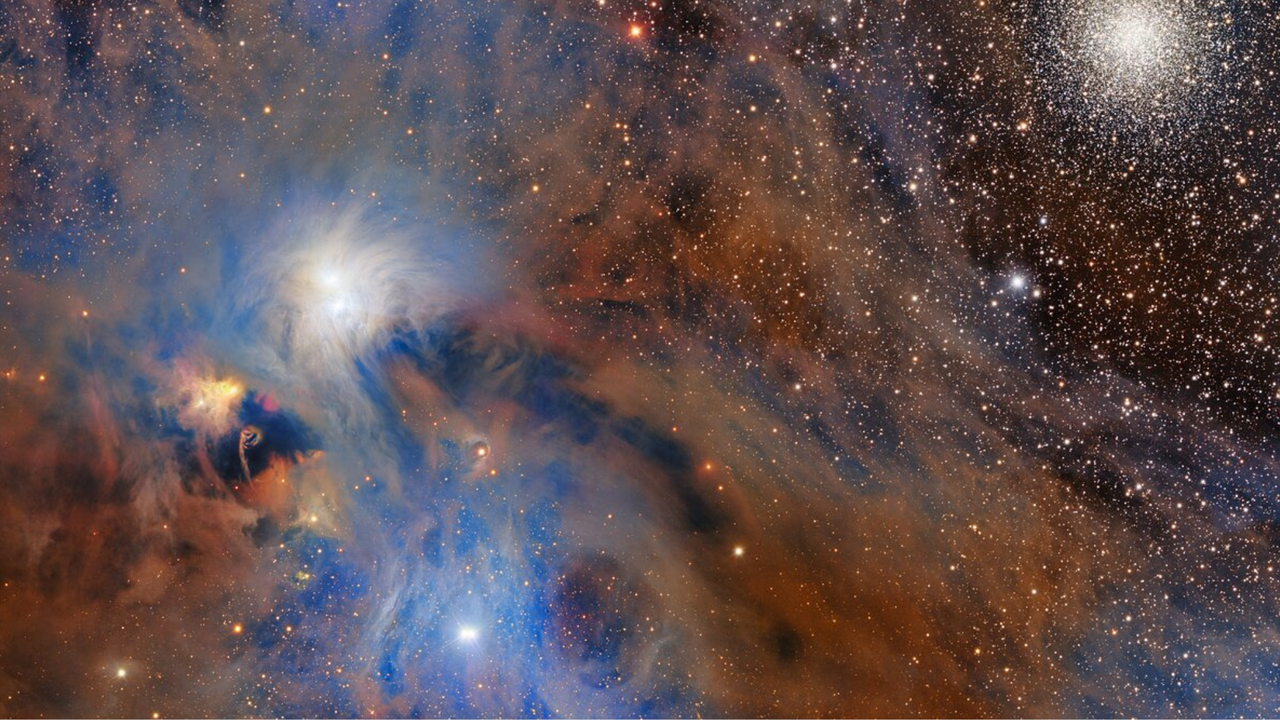
The Dark Energy Camera, an instrument mounted on the 4-meter Blanco Telescope at Cerro Tololo Inter-American Observatory in Chile, captured a new image of the Corona Australis Molecular Cloud that bears a striking resemblance to Vincent van Gogh's The Starry Night. The photograph reveals swirling patterns of dust and gas illuminated by newborn stars, creating the characteristic turbulent brushstroke appearance that echoes the famous painting.
The Corona Australis Molecular Cloud, located roughly 430 light-years from Earth in the southern constellation Corona Australis, represents an active stellar nursery where gravity compresses interstellar gas and dust into new stars. The Dark Energy Camera's sensitivity captures both visible starlight and infrared radiation, allowing astronomers to peer through dust clouds that obscure regions inaccessible to optical telescopes alone.
The resemblance to van Gogh's 1889 work remains largely aesthetic rather than literal. The image shows genuine astrophysical processes, not artistic arrangement. Stellar winds from hot, young stars push surrounding material outward, creating the swirling patterns visible in the data. Dust extinction and scattered light generate the luminous nebulosity characteristic of active star-forming regions.
The Dark Energy Camera operates as part of the Dark Energy Survey, a decades-long project designed to map the universe and understand dark energy, the mysterious force accelerating cosmic expansion. Images like this one emerge as byproducts of that survey work, offering both scientific value and striking visual results.
The image demonstrates how cutting-edge astronomical instrumentation reveals the universe's hidden architecture. While scientists use such observations to study star formation, stellar populations, and interstellar dust properties, the raw data also produces compelling visuals that connect modern astronomy to human artistic traditions. The Corona Australis image shows how van Gogh's intu