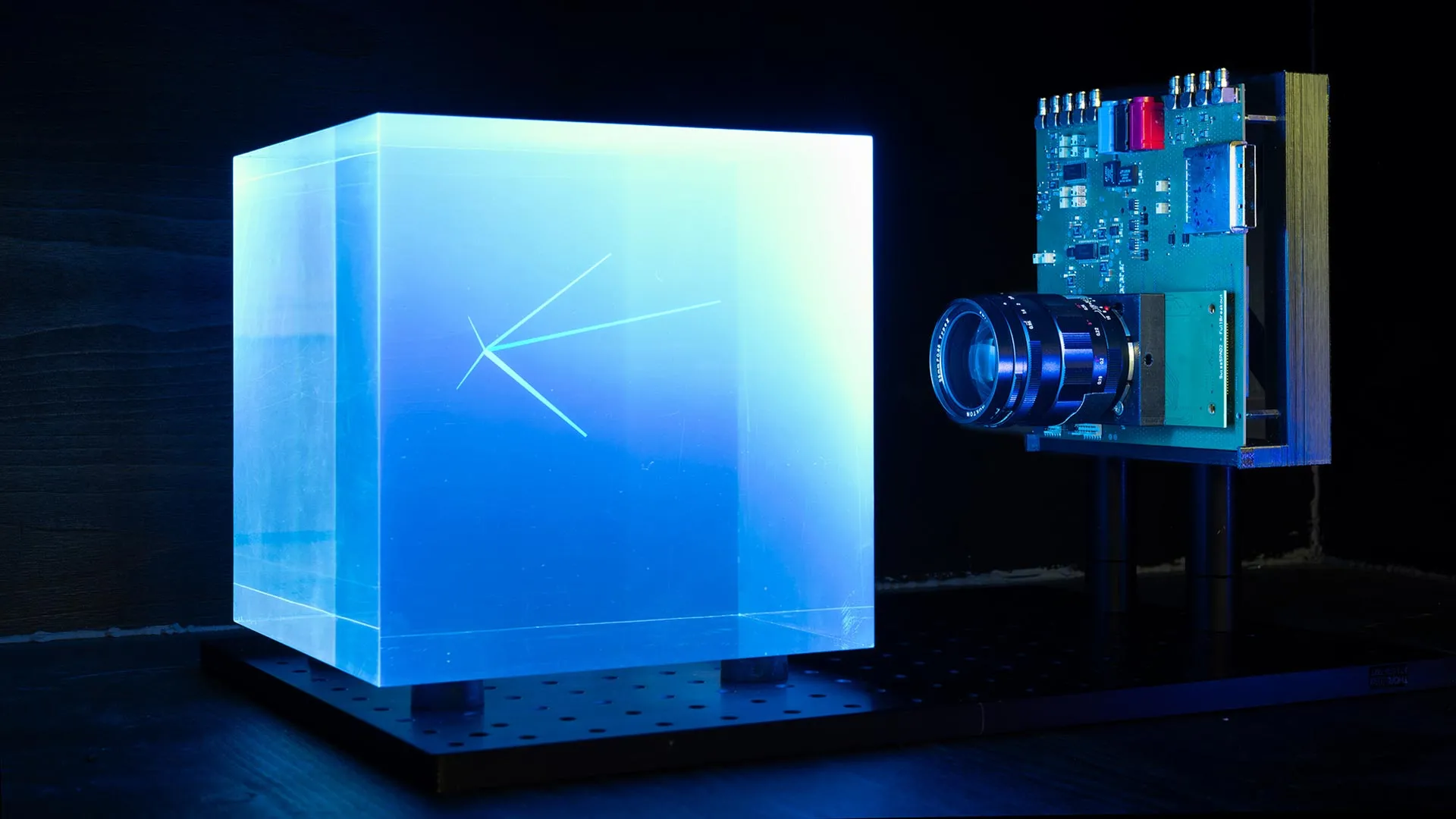
Physicists have developed PLATON, a novel particle detector that uses a single block of light-producing material instead of millions of individual detector components to track invisible particles in three dimensions.
The system combines a light-field camera, highly sensitive photon sensors, and artificial intelligence to reconstruct the paths of charged particles as they pass through the material. When particles interact with the detector block, they produce light signals that the camera captures from multiple angles simultaneously. Machine learning algorithms then process these signals to build detailed 3D trajectories of particle movements.
Computer simulations indicate PLATON could match or exceed the performance of conventional detectors while offering substantial practical advantages. Traditional particle detectors require extensive arrays of separate sensors densely packed together, making them expensive to manufacture and difficult to expand. PLATON's monolithic design eliminates this complexity, potentially reducing costs and enabling easier scaling for larger experiments.
The technology emerged from research combining decades of advances in light-field imaging, photon detection sensitivity, and AI reconstruction techniques. Light-field cameras capture directional information about light rays, allowing the system to determine not just where photons arrive but from which direction. Paired with modern single-photon sensors capable of detecting individual light particles, this architecture provides the position and timing data needed for particle tracking.
Beyond fundamental physics experiments, PLATON could improve medical imaging. Positron emission tomography (PET) scanners, which detect particles from radioactive tracers to visualize tumors and organ function, could produce sharper images using similar principles. Better spatial resolution would help clinicians identify smaller lesions earlier.
The detector still requires testing in actual particle physics experiments to validate simulation results. Real-world performance may differ from predictions, and engineering challenges remain in scaling the technology. However, the combination of elegant design, computational power, and demonstrated simulation success positions PLATON as a promising direction for next-generation particle detection across physics research and