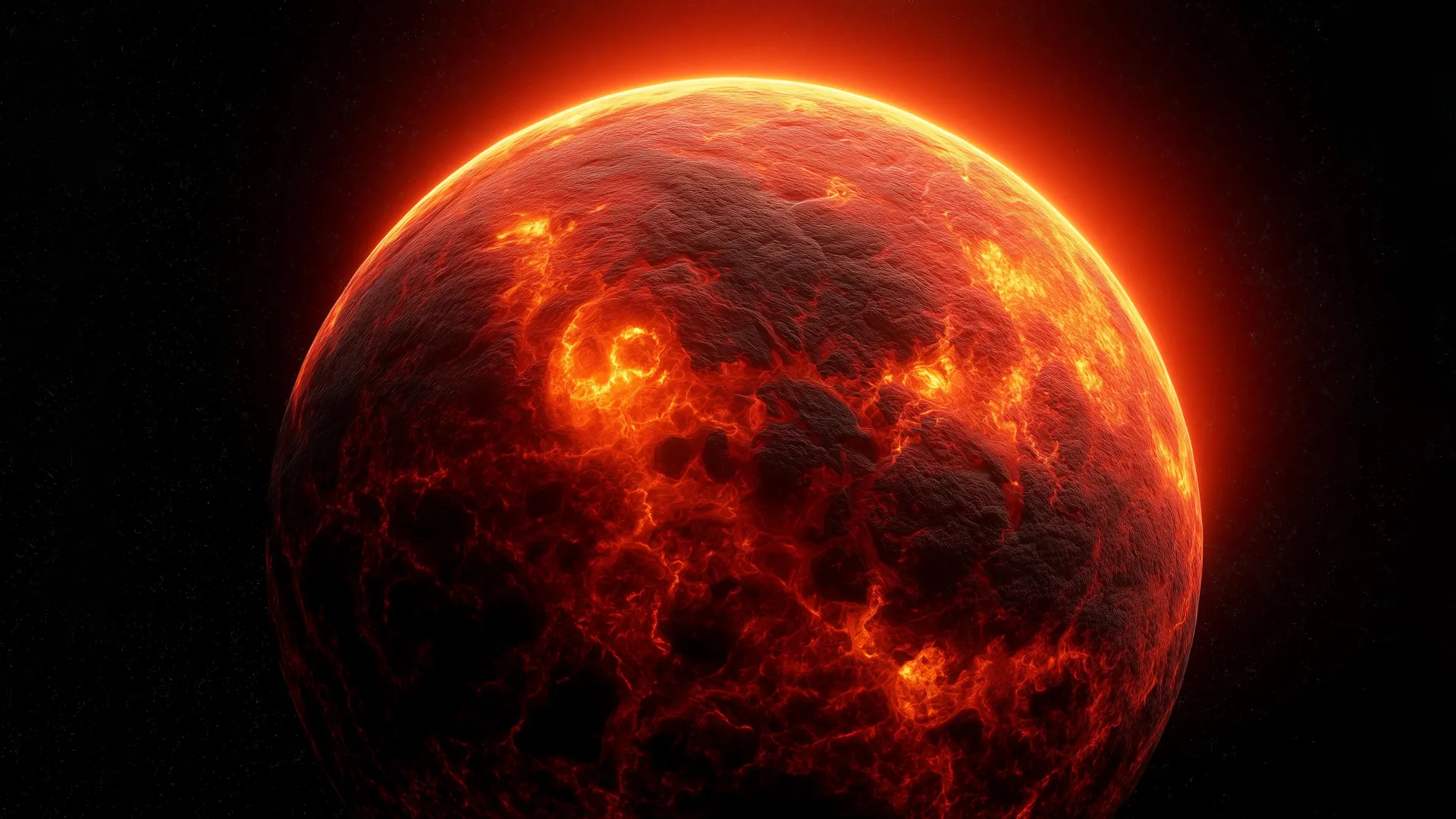
NASA's James Webb Space Telescope has detected an unexpected atmosphere around 55 Cancri e, an ultra-hot exoplanet where surface temperatures exceed 2,000 kilometers (1,200 miles). The discovery reshapes our understanding of how atmospheres persist on planets orbiting extremely close to their host stars.
The planet, located 41 light-years away in the constellation Cancer, orbits so close to its star that it completes one revolution every 18 hours. At such proximity, the star's radiation strips away lighter gases, yet Webb's infrared observations reveal a hydrogen-rich atmosphere persists. Researchers attribute this survival to ongoing volcanic outgassing from the planet's molten interior, which continuously replenishes escaping gases.
The data suggest volcanic activity shapes the atmospheric composition fundamentally. As magma churns beneath the surface, it releases hydrogen and other volatiles into the thin atmosphere. The observations even hint at temporary cloud formation from volcanic gases, creating a dynamic system where the atmosphere continuously exchanges material with the planetary interior.
This discovery challenges previous assumptions about ultra-hot exoplanet atmospheres. Earlier models predicted such worlds would lose their atmospheres entirely within million-year timescales. Webb's findings indicate that for tidally locked planets like 55 Cancri e, which always shows the same face to its star, interior volcanism can sustain an atmosphere despite extreme stellar heating.
The research carries implications for how astronomers characterize distant planets. Understanding atmospheric retention mechanisms on extreme worlds helps refine models for exoplanet habitability and atmospheric escape rates across different planetary types. Webb's infrared capabilities proved essential for detecting molecular signatures at such extreme temperatures, where traditional visible-light telescopes detect nothing.
The observations open new questions about how long 55 Cancri e's atmosphere can survive and whether similar volcanic worlds throughout the galaxy maintain comparable atmospheric features. Future