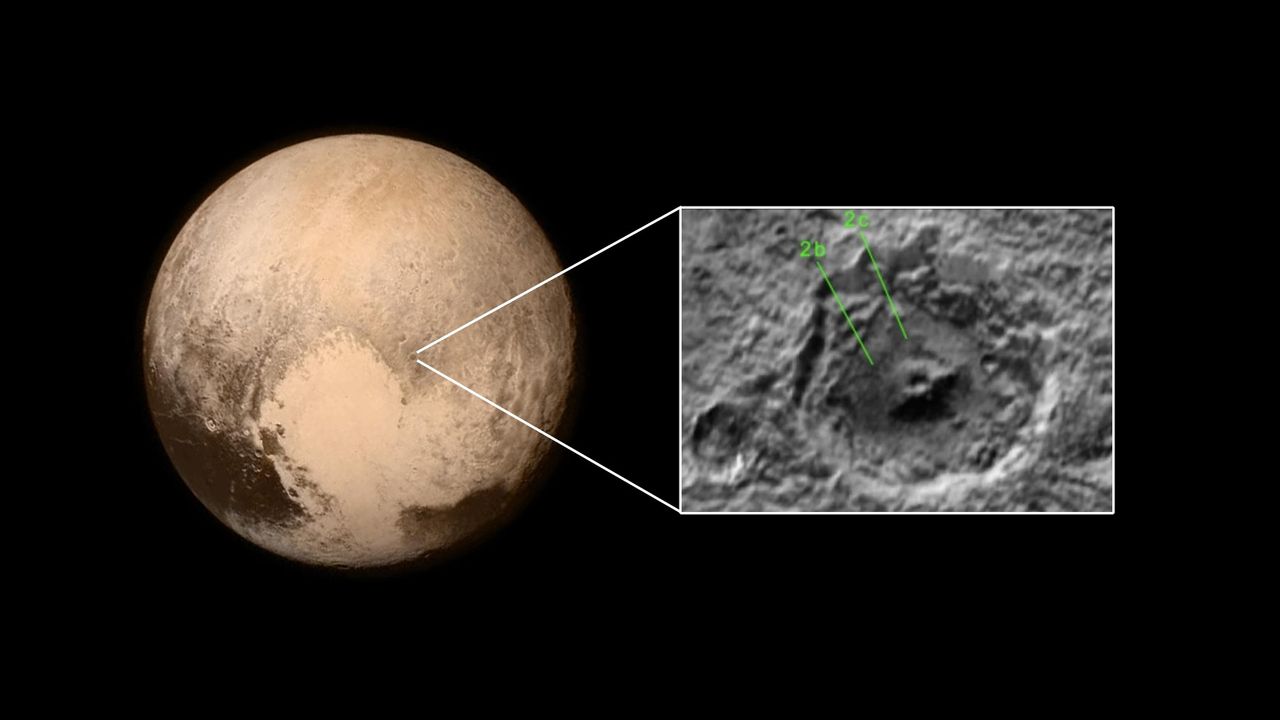
NASA's New Horizons spacecraft has revealed evidence of massive landslides on Pluto's surface, with some large enough to bury entire cities on Earth. Astronomers discovered these geological features cascading down steep crater walls in high-resolution imagery captured during the mission's historic 2015 flyby.
The landslides appear across multiple locations on the distant dwarf planet, suggesting active geological processes shape Pluto's landscape despite its distance from the Sun and frigid surface temperatures. Researchers analyzed the imagery to identify debris fields and scarring patterns consistent with material sliding down crater walls, indicating that Pluto's terrain remains more dynamic than scientists anticipated.
The discovery holds implications for understanding planetary geology beyond our solar system's inner regions. Pluto's extreme conditions, with surface temperatures around minus 380 degrees Fahrenheit, create a fundamentally different environment from Earth. Yet gravity, topography, and material properties still drive landslide mechanics. The dwarf planet's relatively low gravity may allow material to slide farther before stopping, potentially explaining why these features appear so extensive.
New Horizons captured these details during its closest approach to Pluto in July 2015, passing within 7,800 kilometers of the surface. The spacecraft's advanced imaging instruments resolved surface features at scales never before possible, revealing a world far more geologically complex than expected. Before the flyby, scientists viewed Pluto as a static, cratered body similar to other icy moons. Instead, data showed nitrogen ice plains, mountain ranges, and evidence of ongoing processes.
The landslide findings add to the growing picture of Pluto as geologically active. Previous New Horizons data revealed cryovolcanism, nitrogen ice flows, and a layered atmosphere. These observations suggest that internal heat sources, possibly from radioactive decay or residual heat from Pluto's formation, may drive surface