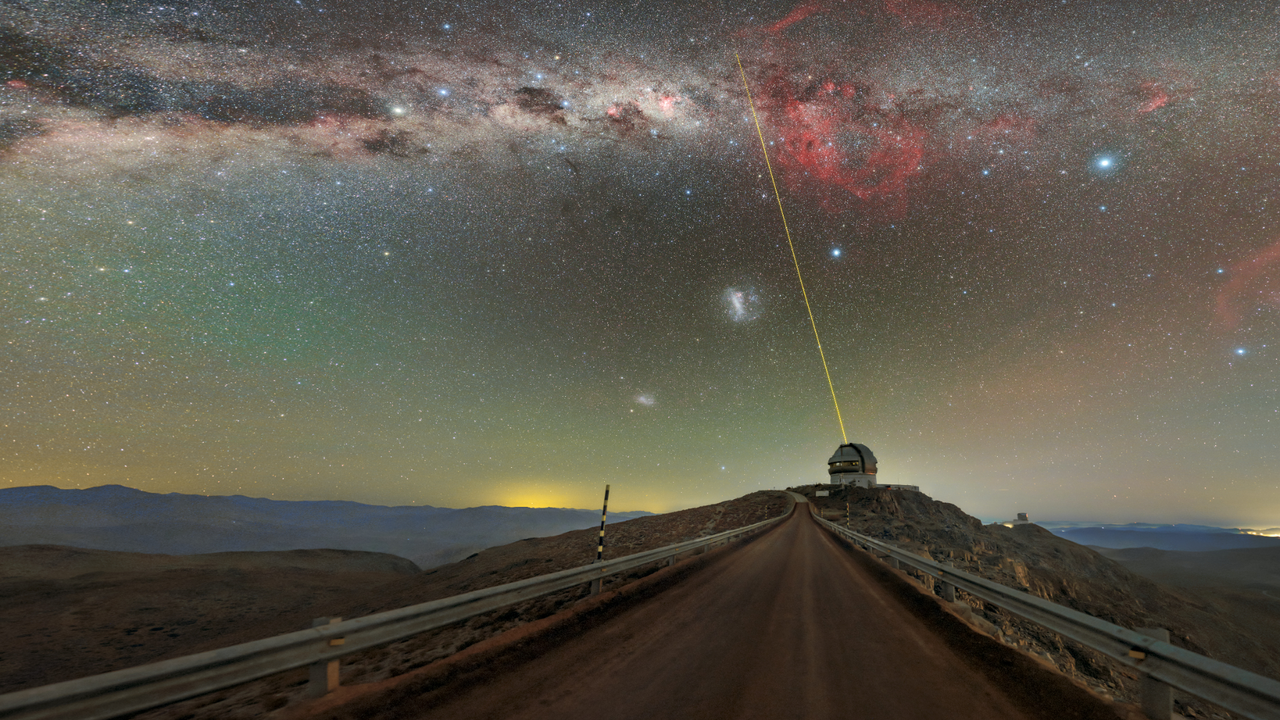
# A Laser Disappears into the Milky Way's Heart
Astronomers used a powerful laser beam to probe the supermassive black hole at the center of the Milky Way, capturing imagery that shows the laser vanishing into the galactic core. The observation demonstrates the extreme gravitational forces at work around Sagittarius A*, the black hole anchoring our galaxy's center.
Researchers directed a laser toward the region surrounding Sagittarius A*, located roughly 26,000 light-years from Earth. The beam's apparent disappearance reveals how the black hole's gravity warps spacetime so severely that light cannot escape once it crosses the event horizon. This gravitational lensing effect bends the laser's path and eventually consumes the beam entirely.
The technique builds on decades of work studying black holes through radio observations and stellar dynamics. The Event Horizon Telescope collaboration produced the first direct image of Sagittarius A* in 2022, showing the black hole's silhouette against hot gas swirling around it. This laser observation complements that work by providing real-time visual evidence of gravitational capture.
The laser approach allows scientists to test predictions made by Einstein's general relativity near the most extreme gravitational environments known. By tracking how the beam behaves as it approaches and enters the event horizon, researchers gather data on spacetime curvature at the black hole's edge. The observation confirms theoretical models while opening new avenues for studying black hole physics.
Understanding Sagittarius A* matters for broader astrophysics. The black hole's properties inform models of how supermassive black holes form and evolve, reshaping understanding of galaxy evolution itself. Future laser observations could detect subtle deviations from general relativity's predictions, potentially revealing new physics.
The work faces limitations. Earth's atmosphere distorts laser beams, requiring sophisticated adaptive op