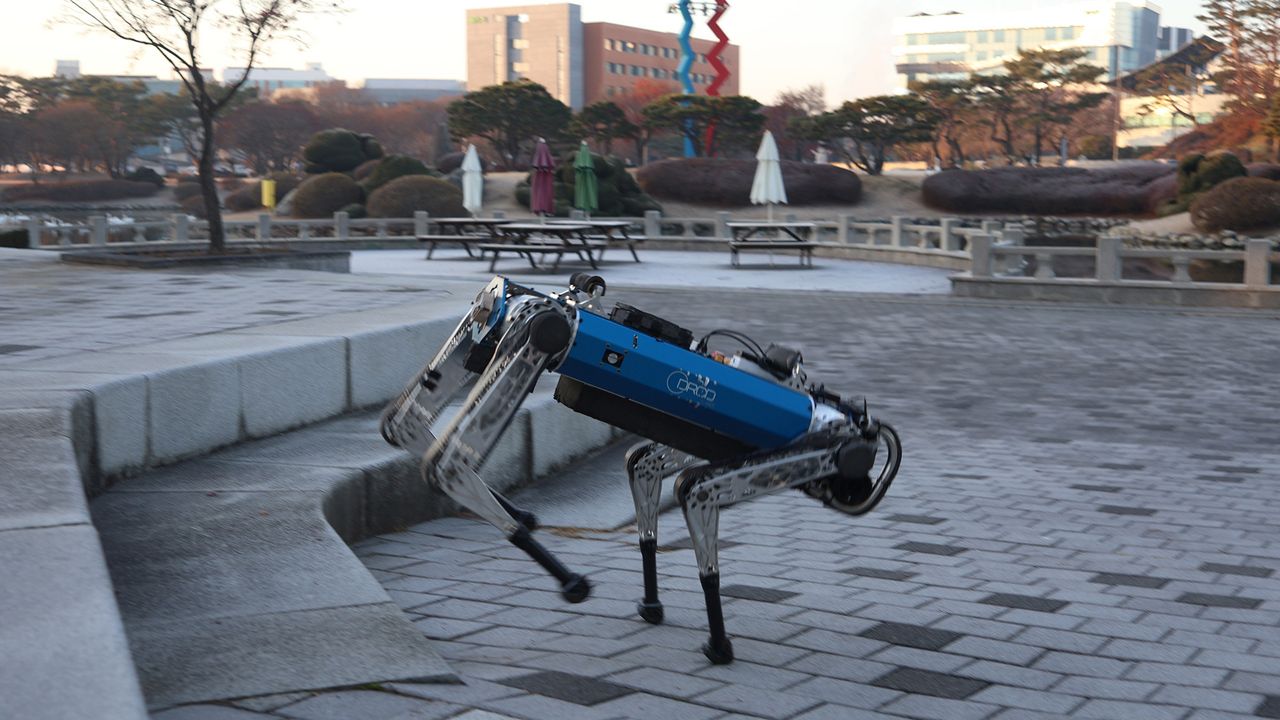
Researchers have trained a quadrupedal robot to navigate complex terrain including stairs, forests, and fallen logs using a rapid reinforcement learning approach. The robot leverages two pre-learned gaits that it can switch between and adapt based on environmental demands.
The technique combines reinforcement learning with pre-trained movement patterns. Rather than teaching the robot locomotion from scratch, engineers equipped it with two foundational gaits. The robot then learns which gait works best for different surfaces and obstacles, allowing it to generalize its skills across diverse environments without extensive retraining for each new terrain type.
This approach addresses a major challenge in robotics: making machines adaptable without requiring prohibitively long training periods. Previous methods often demanded hours or days of computation to train robots for specific tasks. By using pre-learned gaits as a foundation, the new system dramatically reduces training time while expanding the robot's capability to handle unexpected obstacles.
The work demonstrates that quadrupedal robots can develop more sophisticated decision-making about movement. Instead of executing a single programmed gait, the robot now evaluates terrain properties and selects or modifies its approach accordingly. This flexibility mirrors biological locomotion, where animals naturally adjust their movement patterns based on ground conditions.
The research has implications beyond academic robotics. Robots capable of rapid adaptation could eventually assist in search and rescue operations, infrastructure inspection, or exploration in hazardous environments. The faster training process means engineers could deploy updated versions more quickly when new capabilities become necessary.
However, the research operates within controlled parameters. The terrain tested, while varied, remains relatively structured. Real-world deployment would require the robot to handle unpredictable environments and potential equipment failures. Additionally, the robot's battery life and power consumption during these complex maneuvers affect practical mission duration.
The technique also relies on simulation-to-reality transfer, where behaviors learned in virtual environments must successfully translate to physical systems. This