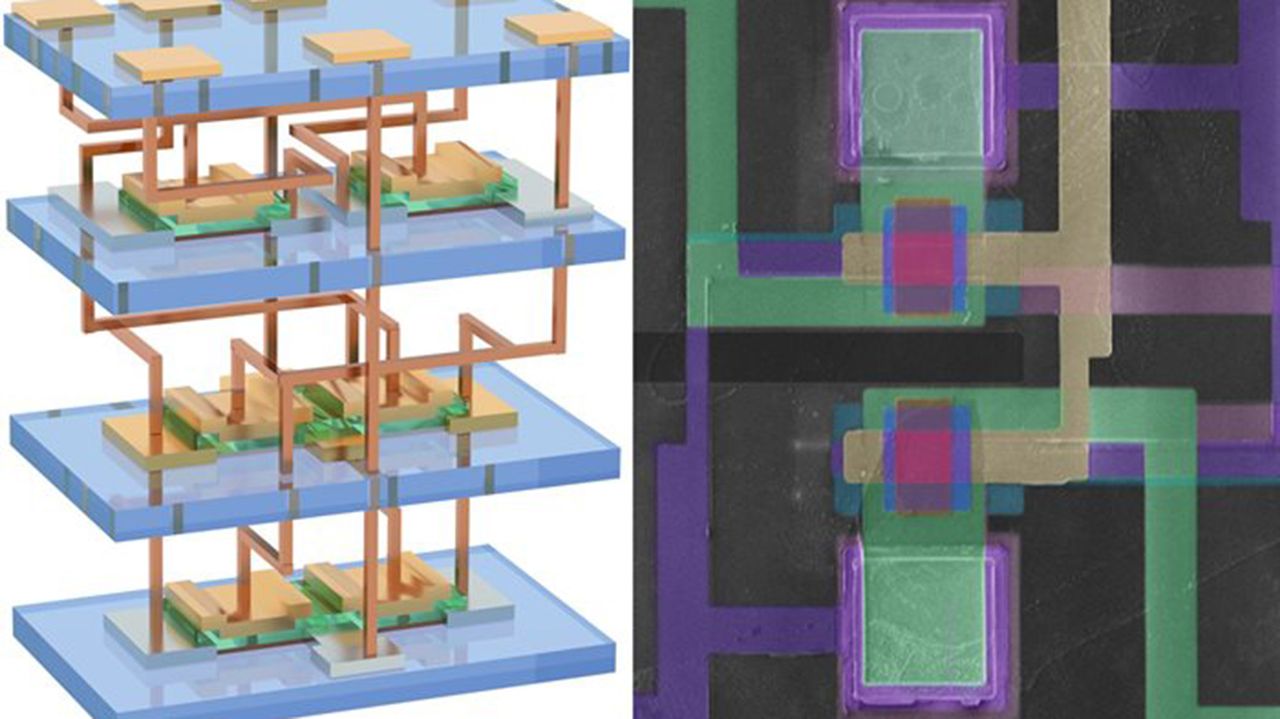
Researchers have achieved a breakthrough in three-dimensional chip architecture by successfully stacking silicon circuits vertically without triggering thermal runaway. The advancement addresses a longstanding engineering challenge that has limited the density of modern processors.
The team demonstrated that multiple layers of silicon can be integrated into a single chip package while maintaining safe operating temperatures. Previous attempts at vertical stacking generated excessive heat from the compressed circuitry, creating a bottleneck for further miniaturization and performance gains.
Heat dissipation remains the primary constraint in modern chip design. When transistors operate in close proximity, the accumulated thermal energy becomes difficult to remove efficiently. By solving this problem, researchers have opened pathways to substantially higher computing densities without sacrificing reliability or lifespan.
Three-dimensional chip stacking offers distinct advantages over traditional planar designs. It reduces the physical footprint while increasing the number of transistors per unit volume, directly translating to faster processing speeds and reduced power consumption. The compact architecture also shortens the distances signals must travel between components, lowering latency.
The work builds on earlier attempts at vertical integration, which faced insurmountable heat management problems. New materials, thermal interfaces, or architectural innovations likely enabled this breakthrough, though specific technical details remain under investigation.
This development has immediate implications for processors used in data centers, artificial intelligence applications, and consumer electronics. Companies pursuing chip design at smaller nanometer nodes face increasing manufacturing difficulties, making three-dimensional approaches increasingly attractive. Stacking multiple functional layers offers an alternative scaling strategy when shrinking transistor dimensions becomes economically or physically impractical.
The ability to build thermally stable three-dimensional chips accelerates the timeline for next-generation computing hardware and reduces reliance on continued progress in traditional lithography. Further refinement could enable four or more layers within a single package, dramatically multiplying processing power while keeping chips compact.