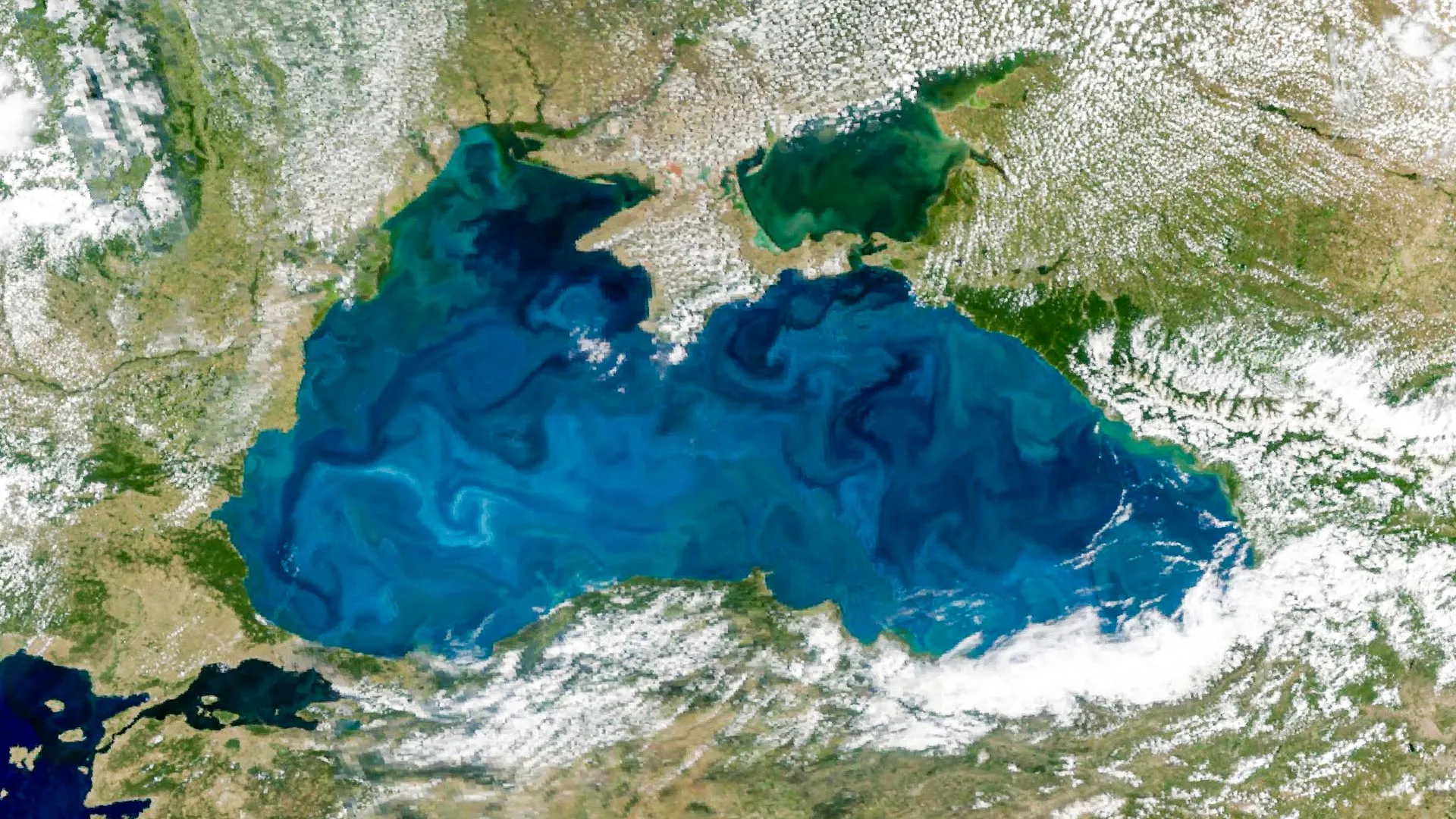
NASA's PACE satellite captured the Black Sea ablaze in turquoise during its annual phytoplankton bloom, revealing one of Earth's most dramatic biological displays from orbit. The brilliant color stems from billions of coccolithophores, single-celled marine organisms whose calcium carbonate shells scatter light so effectively that the bloom becomes visible hundreds of miles above the planet's surface.
These microscopic creatures undergo explosive population growth each spring when nutrient-rich freshwater from rivers mixes with warmer surface waters. The coccolithophores' reflective shells create the distinctive turquoise hue, transforming the normally darker Black Sea into what appears almost like painted water. The PACE satellite, part of NASA's Earth observation fleet, captured the bloom in unprecedented detail using its advanced spectral sensors.
Astronauts aboard the International Space Station also documented the event, photographing swirling patterns as the bloom spread through the Bosphorus Strait. These images revealed the complex fluid dynamics at work, showing how ocean currents direct and shape the phytoplankton masses into intricate formations. The visual record provides scientists with valuable data about the bloom's extent and behavior.
The Black Sea bloom represents both a natural wonder and an ecological indicator. While the blooms occur annually, their intensity and timing can signal shifts in regional climate patterns and nutrient cycling. Coccolithophore blooms release dimethyl sulfide, a compound that influences cloud formation and potentially affects regional climate. Researchers study these events to better understand ocean productivity and how marine ecosystems respond to environmental changes.
The PACE satellite launched in 2024 specifically to observe ocean biology and color from space, making it ideally suited to capture such phenomena. Its instruments measure how phytoplankton abundance and composition change across ocean basins, data essential for tracking ocean health and predicting harmful algal blooms. This turquoise