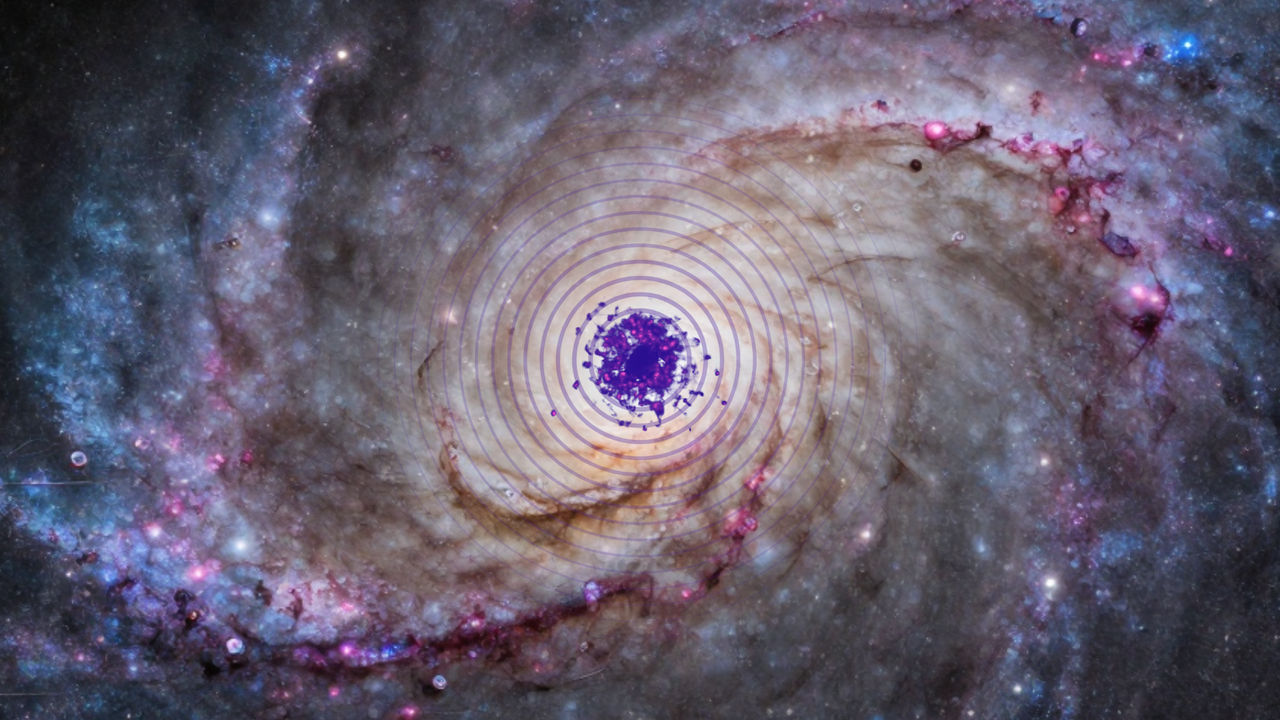
Researchers exploring the intersection of dark matter and extra dimensions have proposed a novel connection between two of physics' deepest unsolved problems. The work suggests that dark matter particles may interact with hidden spatial dimensions beyond the three we perceive, offering a fresh theoretical framework for understanding both phenomena simultaneously.
Dark matter comprises roughly 85 percent of the matter in the universe yet remains invisible to direct observation. Scientists detect its effects only through gravitational influence on visible matter, radiation, and galaxy rotation. Higher dimensions, predicted by string theory and other advanced physics models, exist theoretically but have never been directly confirmed experimentally.
The new research proposes that dark matter particles could be concentrated in or coupled to extra dimensions in ways that would explain some of dark matter's peculiar properties. If correct, this framework could resolve inconsistencies in current dark matter models and provide testable predictions about how dark matter behaves in relation to ordinary matter.
The significance of this work lies in its potential to bridge two separate research frontiers. Rather than treating dark matter and dimensional physics as independent puzzles, connecting them through a unified model could accelerate progress on both fronts. Experimental physicists could design new detection methods targeting particles with properties predicted by this dimensional coupling.
However, the research remains highly theoretical. Extra dimensions have evaded detection despite decades of experiments at facilities like the Large Hadron Collider. The proposed dark matter-dimension connection requires substantial additional evidence and refinement before gaining broad acceptance in the physics community. Researchers must develop concrete, testable predictions that distinguish this model from existing dark matter theories.
The work demonstrates how fundamental physics advances often emerge from reconsidering relationships between established mysteries rather than attacking each problem in isolation. Whether this dimensional angle truly illuminates dark matter's nature depends on future experimental validation and theoretical development.