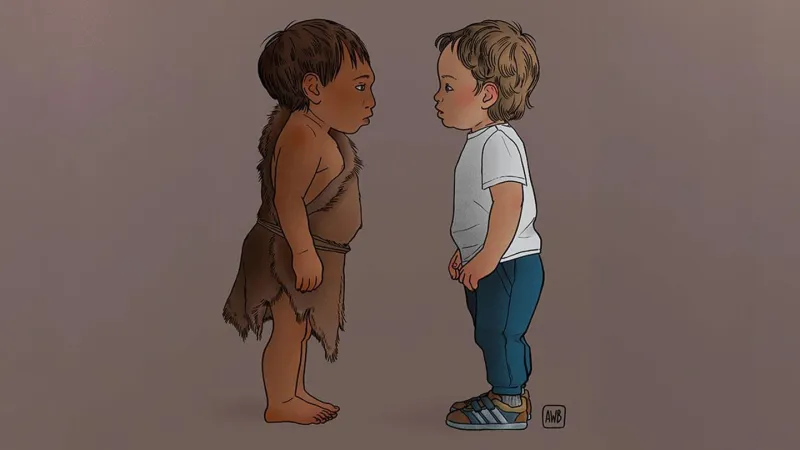
Neandertals gave birth to babies roughly the same size as modern human newborns, but those infants grew up faster and followed a different developmental trajectory, according to two new studies of skeletal remains.
Researchers analyzed growth patterns in Neandertal fossils by examining tooth development and bone structure. The findings reveal that Neandertal infants started life similarly to Homo sapiens newborns in terms of body size and head proportions. However, after birth, their developmental path diverged sharply. Neandertal children progressed through infancy more rapidly than modern humans, reaching physical maturity at younger ages.
The faster development rate has implications for understanding Neandertal behavior and social structure. Extended childhood dependency in modern humans allows for prolonged learning periods and cultural transmission. Neandertals, by contrast, would have required less parental investment during early childhood, potentially affecting social bonding and knowledge transfer across generations.
One team examined dental development patterns, which provide reliable markers for biological age in primate fossils. Another analyzed bone density and structural growth indicators from juvenile specimens. Both approaches converged on the same conclusion: Neandertal ontogeny, or developmental trajectory, differed fundamentally from that of modern humans despite similar birth sizes.
The research challenges assumptions that larger brains necessarily require extended childhoods. While Neandertals possessed robust skulls and substantial brain volumes, they compressed their physical development into shorter timeframes. This finding opens questions about cognitive development rates and how Neandertal children acquired skills and knowledge within their societies.
These studies employ established paleoanthropological methods but rely on limited fossil samples. Interpreting developmental rates from skeletal remains requires caution, as soft tissue changes and behavioral development leave no direct fossil record. Researchers emphasize that growth differences alone cannot determine whether Neandertal cognitive or social development parall