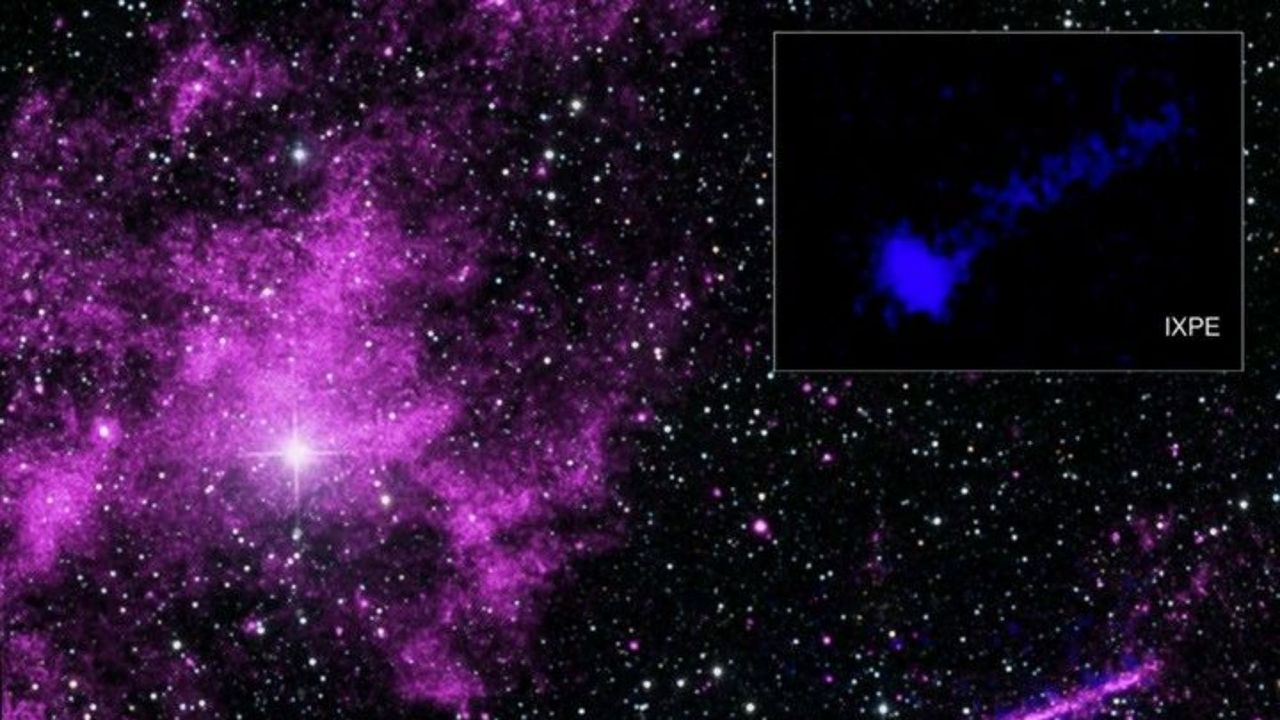
Astronomers have directly mapped the magnetic field around an unusual pulsar in the Milky Way, validating theoretical predictions about how charged particles escape from these spinning neutron stars. The research marks the first time scientists have achieved this kind of detailed observation of a pulsar's magnetic environment.
Pulsars emit radiation as they rotate, creating a lighthouse-like effect visible from Earth. This particular pulsar behaves differently from typical ones, making it an ideal laboratory for testing decades-old models of particle acceleration. The magnetic field acts as a confining structure, channeling streams of high-energy particles away from the neutron star's surface.
The team used radio observations to trace the magnetic geometry surrounding the pulsar. By analyzing how radiation travels through this field, researchers determined the structure and strength of the magnetic environment. This direct mapping confirms what theorists predicted: particles follow specific paths determined by the field's configuration, streaming outward in organized patterns rather than dispersing randomly.
The findings validate magnetohydrodynamic models that physicists developed to explain pulsar behavior. These models describe how magnetic forces interact with charged particles in extreme conditions. Understanding this process helps astronomers interpret observations of similar objects throughout the galaxy and beyond.
Pulsars represent some of the densest matter in the universe. A teaspoon of neutron star material would weigh as much as a mountain on Earth. Their extreme density creates the strongest magnetic fields known to science, billions of times stronger than Earth's field. Mapping these fields directly provides insights into physics that cannot be replicated in laboratories.
The discovery has implications for understanding particle acceleration mechanisms in astrophysical environments. Similar processes occur near black holes, supernova remnants, and active galactic nuclei. By studying how pulsars launch particles, scientists gain tools to interpret high-energy phenomena across the cosmos.
This pulsar acts as a natural accelerator, converting rotational