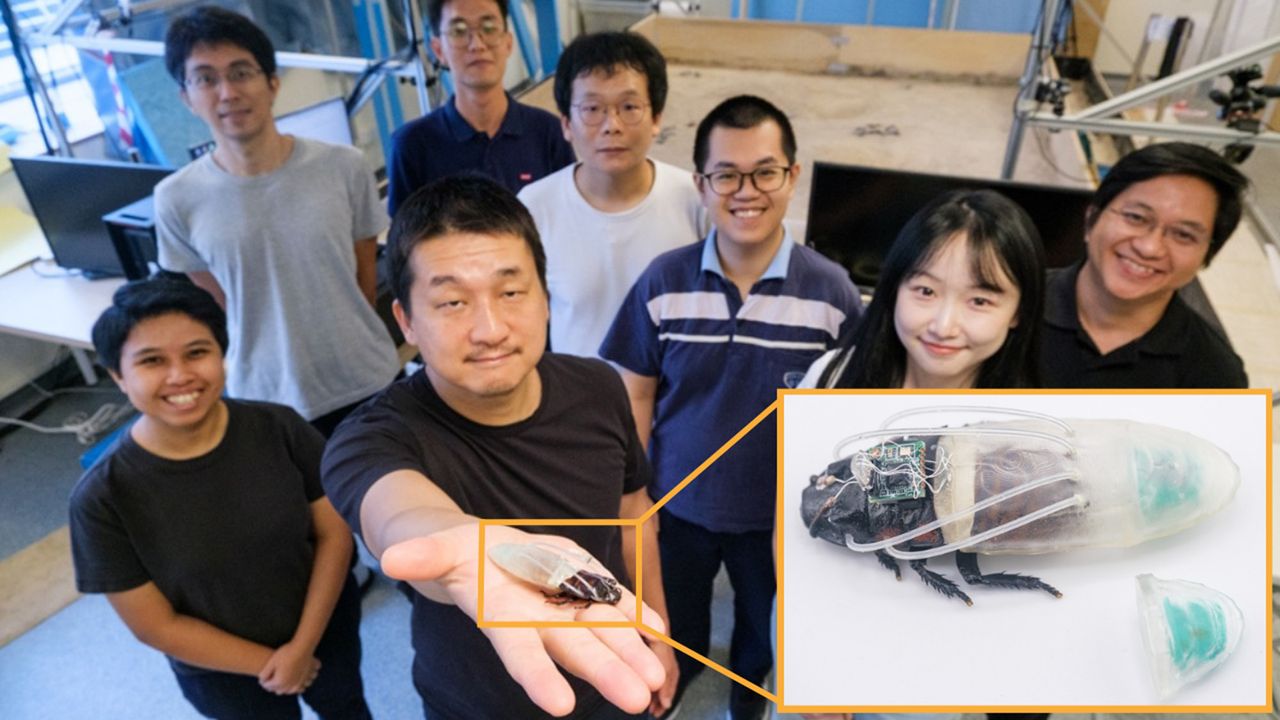
Researchers at institutions in Singapore and Japan have engineered a waterproof exoskeleton for cockroaches, transforming the insects into aquatic search-and-rescue drones. The device functions as a protective shell that allows the naturally water-resistant arthropods to operate in flooded disaster zones.
Cockroaches possess several advantages for rescue operations. They navigate tight spaces, survive extreme conditions, and require minimal power compared to conventional robots. The team designed a miniature diving suit that encases the insect's body while maintaining its mobility and sensory capabilities. The shell uses waterproof materials and seals to protect the cockroach's respiratory spiracles, the openings through which insects breathe.
The cyborg cockroaches can be equipped with sensors and cameras to transmit real-time data from submerged environments. Their small size enables them to access confined areas unreachable by larger search-and-rescue equipment. After flooding events like tsunamis or heavy storms, these robotic insects could locate survivors, assess structural damage, and identify hazards before human rescue teams enter dangerous zones.
This research builds on years of work in biohybrid robotics, where scientists combine living organisms with electronic components. Previous projects have used insects to carry miniature cameras or stimulate movement through neural implants. The Singapore-Japan collaboration represents a step toward practical disaster response applications.
The diving suits remain in early development stages. Researchers must optimize battery life, extend operational duration, and refine control systems before deployment in actual emergencies. Testing in controlled laboratory environments has demonstrated proof-of-concept, but field trials in realistic disaster scenarios remain forthcoming.
The project highlights how biological systems can enhance technological limitations. Cockroaches' evolutionary adaptations and inherent resilience provide capabilities that purely mechanical robots struggle to replicate at comparable size and energy efficiency. As climate change increases flooding risks globally, such innovations may