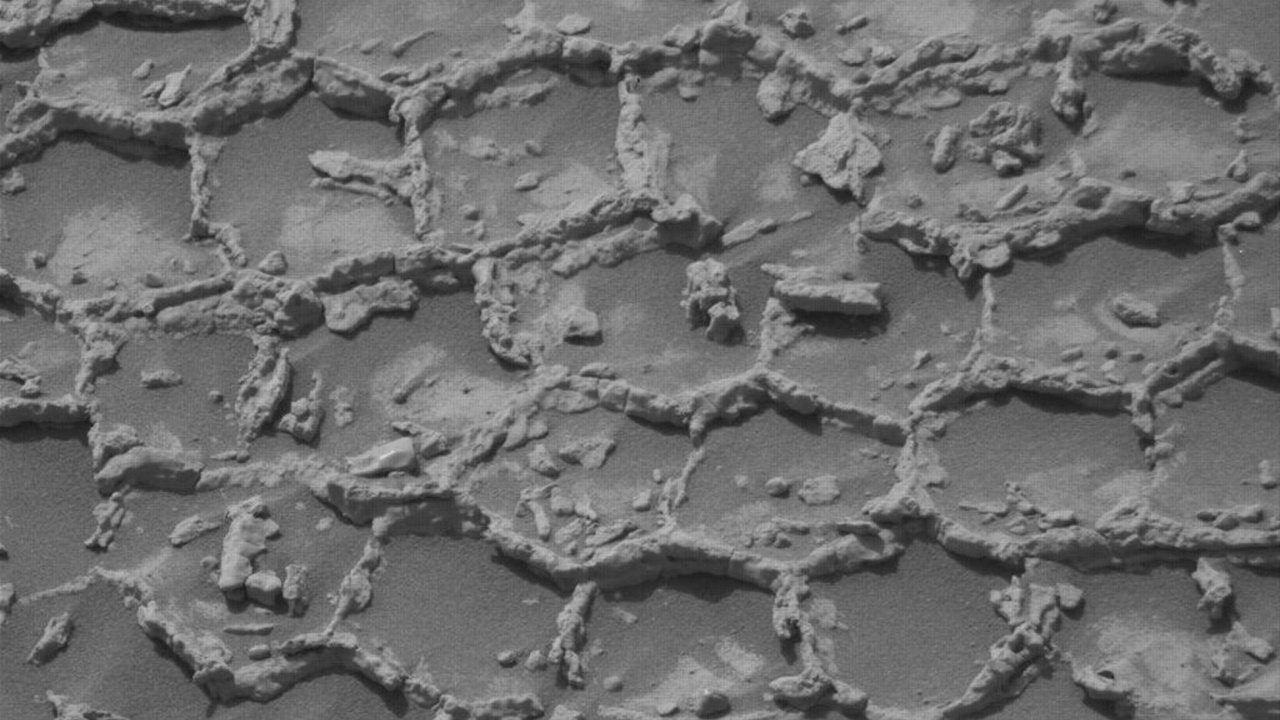
NASA's Mars Reconnaissance Orbiter captured high-resolution images revealing distinctive honeycomb-patterned structures across portions of the Martian surface, according to Space.com's July 14, 2026 space photo feature.
The hexagonal formations appear in the planet's polar regions, where researchers believe they formed through processes of frost accumulation and sublimation over millions of years. As dry ice and water ice alternate between freezing and vaporizing, they create stress patterns in the Martian regolith that eventually crack into the characteristic honeycomb shapes observed in the orbiter's imagery.
Similar patterns exist in Earth's polar regions, where repeated freeze-thaw cycles produce analogous formations. The Martian examples extend across areas larger than terrestrial equivalents, suggesting the process operates over longer timescales on Mars given the planet's thinner atmosphere and lower temperatures.
These structures hold implications beyond visual interest. They indicate where subsurface ice concentrations exist and provide clues about Mars' climate history. Understanding the distribution and formation mechanisms of these features helps scientists assess water availability and assess whether certain Martian locations could support future human exploration efforts.
The Mars Reconnaissance Orbiter, which has been operational since 2006, continues capturing data through its High Resolution Imaging Science Experiment (HiRISE) camera. HiRISE's resolution reaches approximately 0.3 meters per pixel, allowing researchers to identify surface features previously invisible to earlier instruments.
The honeycomb formations join other notable Martian surface discoveries made by the orbiter, including layered deposits, ancient river valleys, and dark recurring slope lineae that may indicate subsurface water flow. Each discovery refines the picture of Mars as a geologically active world shaped by climate cycles and internal processes.