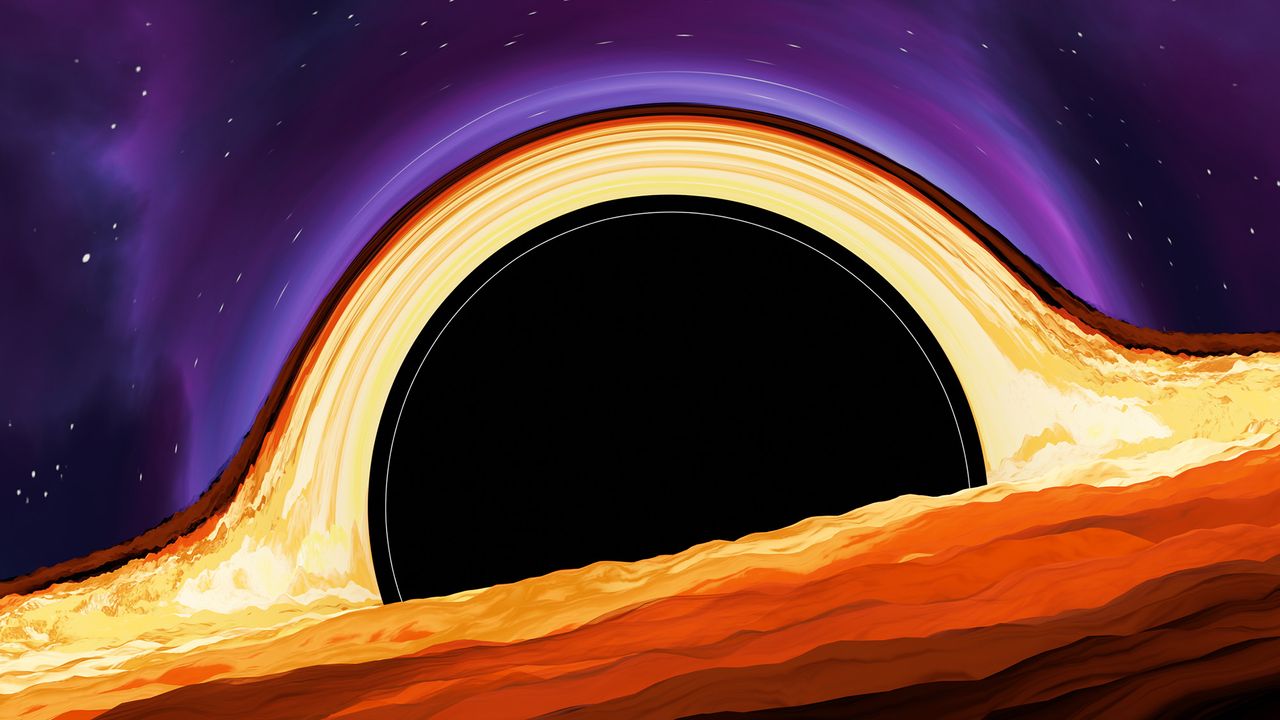
Physicists have detected a novel gravitational wave signal emanating from the region immediately surrounding a black hole's event horizon, marking the first direct observation of what researchers call the "last sound" before matter crosses the point of no return.
The detection emerged from analysis of gravitational wave data collected by the Laser Interferometer Gravitational-Wave Observatory (LIGO) and the Virgo detector. The signal captures vibrations from the merger of two black holes, with the distinctive acoustic signature originating from the immediate vicinity of the event horizon itself.
This breakthrough reveals previously inaccessible physics near black holes. The event horizon represents the boundary beyond which nothing, not even light, can escape a black hole's gravitational pull. Direct observation of its behavior has remained theoretical until now. The new signal provides concrete data about spacetime distortion at the extreme conditions that exist at this cosmic threshold.
The researchers isolated this signal through advanced data analysis techniques that separate the merger signal from background noise in detector recordings. The "last sound" corresponds to the ringdown phase of the collision, when the newly formed black hole settles into its final state by shedding excess energy as gravitational waves. Earlier detections captured the inspiral and merger phases, but this analysis specifically isolated the post-merger oscillation near the event horizon itself.
The discovery holds implications for testing general relativity under extreme conditions and understanding black hole thermodynamics. Scientists can now compare observations against predictions from Einstein's theory of gravity. Deviations from expected behavior could point toward new physics governing spacetime at the smallest scales.
The finding also advances gravitational wave astronomy's technical capabilities. As detector sensitivity improves through upgrades at LIGO and construction of new facilities like the Einstein Telescope in Europe, researchers expect to extract increasingly detailed information from such signals. Future observations may reveal subtleties about black hole composition and the nature of the event horizon itself.