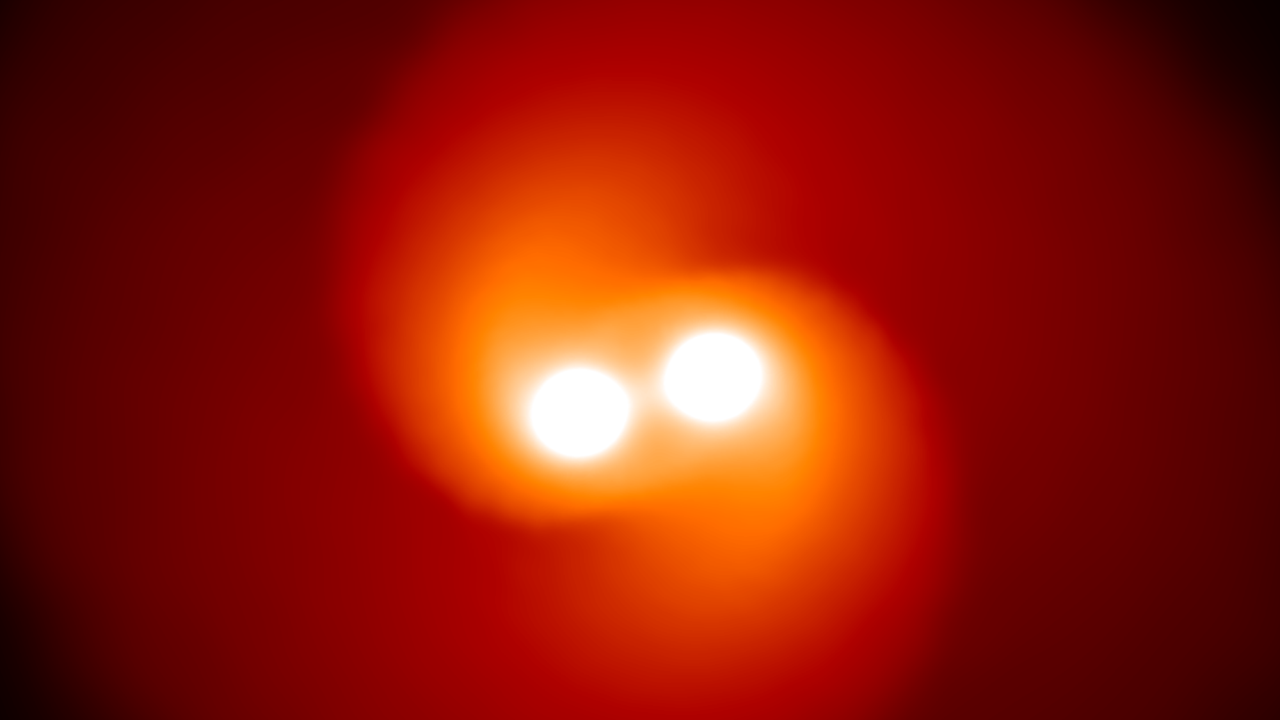
Astronomers have identified a new mechanism for interacting supernovae involving binary star systems, potentially resolving decades of questions about how these unusual cosmic explosions occur.
Interacting supernovae happen when a dying star ejects material that collides with a nearby companion star, creating distinctive light patterns that differ from standard supernova events. The exact physical processes driving these explosions have remained poorly understood, leaving a gap in astronomers' models of stellar death.
The research reveals that when one star in a binary system reaches the end of its life, its expanding outer layers interact dynamically with its orbiting partner. This gravitational dance creates shearing forces and heating effects that dramatically alter the explosion's brightness and spectral signature. The interaction between the two stars fundamentally reshapes how the supernova appears from Earth.
This discovery addresses a long-standing puzzle: why some supernovae show evidence of hydrogen-rich material in their spectra, unlike the cleaner explosions of isolated massive stars. The presence of a nearby companion star explains both the hydrogen signatures and the complex light curves astronomers have catalogued for decades.
The findings build on decades of observational data from ground-based telescopes and space observatories, which captured the detailed behavior of these binary systems during their final moments. Researchers combined spectroscopic analysis with computer simulations to model how the stellar winds from the dying star collide with and heat the companion's outer atmosphere.
Understanding interacting supernovae matters for mapping the universe's cosmic distance scale. Astronomers use supernovae as cosmic "standard candles" to measure distances to far galaxies, but different supernova types behave differently. Clarifying the physics of interacting supernovae improves the accuracy of these distance measurements, which in turn refines estimates of the universe's expansion rate and age.
The work also illuminates the diverse ways stars can end their lives.